Testimonies of War and Memory: The Story of Thomas White and the Armenian Tragedy of 1915
 16:30 24 April, 2026
Thomas White, one of the first four airmen in the Australian armed forces, long after completing his forced 1,500-kilometre journey across the Ottoman Empire, would recall the silence of Tel Armen.
Captured in late 1915 while attempting to cut telegraph wires behind enemy lines, the prisoner of war arrived in an Armenian town only to find it seemingly emptied out, Financial Review reports.
“Only a few women and children of the Christian population remained,” White later wrote. “The male Armenians were conspicuously absent.”
From a small hill, White discovered the reason: 30 fresh graves that “eloquently testified” to the fate of the town’s missing men.
He recalled the pleading gaze of an Armenian child whom he was powerless to help, and noted with horror that these massacres — “the Turk’s handiwork” — were not random acts, but carried out “by order throughout the country.”
Although White published his memoirs in 1928, the history he witnessed remains politically sensitive. Despite the fact that ANZAC forces (the Australian and New Zealand Army Corps) rescued tens of thousands of destitute Armenians across the deserts of Jordan, Iraq, and Syria, these efforts have largely been forgotten.
Today, Australia refuses to join more than 40 countries that have officially recognized the Armenian Genocide — a tragedy that began just one day before the ANZAC landing at Gallipoli.
Armenian-Australian historian Vicken Babkenian argues that the lack of recognition diminishes the legacy and courage of men like White.
“Australians — light horsemen, airmen, and nurses serving in the British Empire’s armies in the Middle East — often encountered Armenian victims of the Ottoman Empire… Like Australians in the Second World War who saw concentration camps, they faced some of the war’s most vulnerable victims. Those Australians who protected or rescued Armenians were truly fighting for humanity.”
Tom Harley, White’s grandson, remembers his grandfather as a man who “ran toward gunfire as soon as he heard it.” White was a daredevil, pilot, and later a politician.
He served in both World Wars, received the Distinguished Flying Cross, and later became a minister in the Menzies government and Australia’s ambassador to London.
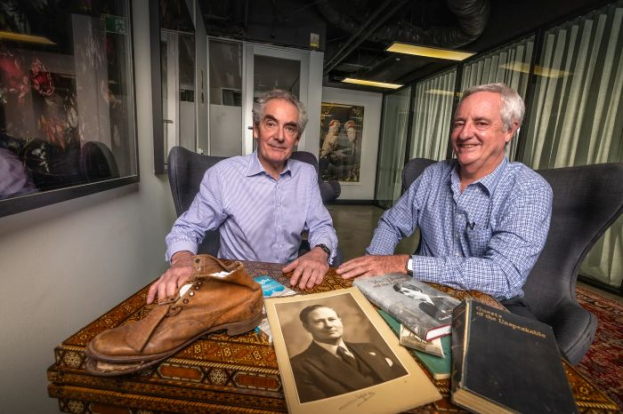
However, it was his three years as a Turkish prisoner during the First World War that made him a writer, Harley says. The family still preserves one of his boots — inside which White hid his diaries, concealing handwritten pages in the sole (the other boot is held at the Australian War Memorial).
“My grandfather was both lucky and unlucky,” Harley says. Thousands of prisoners of war did not survive captivity.
White wrote his prison memoir Guests of the Unspeakable as a tribute to those who died. He wrote candidly about the brutality of Turkish guards, sharply contrasting with the image of the “decent Johnny Turk” that emerged in Australia after Gallipoli.
He also described, without embellishment, other horrors he witnessed, including the treatment of Christian minorities of the Ottoman Empire, particularly the Armenians.
Inside the Ottoman Empire during the war, White and his fellow prisoners — British, French, Russian, and other ANZAC soldiers — witnessed massacres and deportations of Armenian civilians.
At times, soldiers walked the same roads as Armenian women and children — starving, sick, and traumatized. At other times, they were housed in abandoned Armenian homes along the route.
Further evidence came in Hasanbeyli — “a large Armenian village of sandstone houses clinging to a mountainside,” which had been completely emptied. Its inhabitants, White wrote, had been “butchered a la Turque.”
Later, in the village of Ras al-Ain, White observed an earlier stage of deportation: “a large camp of Armenians, herded together after mass roundups and waiting to be sent on marches that always ended the same way.” He later learned that in 1918 there was a “general slaughter of these unfortunates.”
When the prisoners were taken to their final destination — a major POW holding centre in western Turkey — White and his group were housed in recently emptied Armenian homes.
However, after three prisoners escaped, all remaining Allied soldiers were moved into the main Armenian church — a fortified structure that made escape more difficult.
Even there, White noted, their presence meant displacing Armenians who had taken refuge in the church. He described women and children sitting on bundles of clothing, “very sad and miserable… Their men had been killed, their homes and possessions confiscated, and now they were being expelled from their last possible sanctuary.”
The deportations and killings of Christian minorities were witnessed not only by Australian prisoners of war. In the final stages of the war in 1918, ANZAC forces advancing through Syria and Jordan encountered thousands of Armenian and other Christian refugees and provided assistance.
In Armenia, Australia and the Great War, Babkenian and co-author Peter Stanley describe one such encounter in Jordan near Es-Salt, west of Amman, where soldiers came across a group of exhausted refugees, including around 100 children.
The soldiers escorted them to Jerusalem, which had been under British control since Christmas 1917.
Babkenian writes that Lieutenant Colonel Arthur Mills carried a four-year-old Armenian girl, “sleeping in his arms, on his camel,” into Jerusalem.
Historians estimate that between 800,000 and 1.5 million Armenians were killed: men executed, women and children starved, abducted, forcibly converted to Islam, and sent on “death marches” through modern-day Turkey into the Syrian and Iraqi deserts.
Every year on April 24, Armenians around the world commemorate the victims of the Genocide — one day before Australians observe ANZAC Day.
Despite extensive historical evidence, the Australian government has still not officially recognized the Armenian Genocide.
Dr. Deborah Mayersen argues that there is no doubt the actions of the Ottoman Empire meet the definition of genocide. However, Turkey continues to deny this, disputing both the scale and the intent.
Thus, the story of Thomas White and other witnesses remains not only part of the past, but also a powerful reminder of how memory, testimony, and political decisions shape our understanding of history.