Parmesan: The Cheese Used as Bank Collateral
 19:20 4 June, 2026
What do medieval monasteries in Italy’s Emilia-Romagna region and a local bank founded in 1910 have in common? Both turned food preservation into a daily profession. In their own ways and in different eras, monks and bankers pursued the same goal in the same region: to profit from a unique product — cheese capable of lasting for years and increasing in value as it matures. Once a means of survival for monks in the twelfth century, this product is now part of Italy’s gastronomic heritage and forms the basis of a financial model so unusual that it is studied at Harvard Business School, according to El País.
The uniqueness of this model lies in the fact that the bank — Credem — accepts wheels of cheese as collateral when issuing loans to producers. The financial institution lends between 60% and 80% of the current value of the product and stores it in its own warehouses. If the producer fails to repay the loan, the bank recovers its money by selling the cheese it has itself aged.
The system works successfully thanks to the high economic value of the product — an estimated 325 million euros (378 million US dollars) worth of cheese is stored in these facilities — and its impeccable global culinary reputation. The collateral is not just any cheese, but authentic wheels of Parmigiano Reggiano.
This cheese is one of Italy’s most traditional products and one of its greatest ambassadors abroad. In many parts of the world, the taste and appearance of Parmigiano Reggiano are better known than the geographical regions of Parma, Reggio Emilia, Mantua, Bologna, and Modena — the only places on Earth where it can legally be produced under that name. This is not an exaggeration. With nearly 84,000 tons exported annually, the cheese is deeply tied to the history, land, and culture of these five Italian provinces. For this reason, it has held Protected Designation of Origin status for thirty years, both because of its unique qualities and due to the abundance of counterfeits.
A Two-Billion-Dollar Theft
Parmesan is protected by intellectual property rights. In Europe, PDO certification guarantees its origin, ingredients, and production methods. It also prohibits similar cheeses from using the name or misleading labels such as “style Parmesan” or “Parmesan-type.” However, outside the European Union, the situation is very different, to the point that this cheese is one of the most counterfeited products in the world — a market worth millions.
“The phenomenon of imitation is most widespread in North and Latin America, as well as in parts of Asia, where the term ‘Parmesan’ is often used as a generic name for hard grated cheeses or similar products,” explains Fabrizio Raimondi, communications manager of the Parmigiano Reggiano Consortium. “These products try to evoke our cheese through names, colors, images, or packaging associated with Italy, but they have nothing to do with the territory or the strict PDO standards.”
According to the Consortium, the counterfeit market imitating Parmigiano Reggiano is valued at more than 2 billion euros.
Milk, Rennet, Salt… and Time
The Parmesan recipe has not changed for a thousand years. To produce just one wheel of Parmigiano Reggiano, 520 liters of raw milk are required. The finished wheel initially weighs around 50 kilograms, but loses weight during aging as moisture evaporates. Calf rennet — a natural enzyme used to curdle milk — is added, along with a large amount of salt: in the early stage of production, the wheels are submerged in brine for three weeks. The salt helps remove moisture and acts as a preservative, but it takes almost ten months to reach the center of the cheese. That is why the fourth and most important ingredient is time.
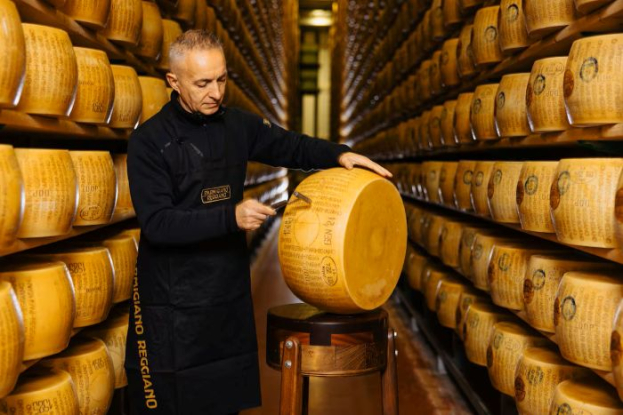
The wheels rest on long wooden shelves for a year awaiting quality inspection. During this test, an expert gently taps the rind with a small hammer, carefully listening to the sound. If no defects such as cracks or internal air pockets are detected, the wheel receives a quality mark — a brand burned directly onto its surface.
From that moment, the cheese continues to mature until it is ready for market, and its culinary journey extends far beyond a simple topping for pasta.
“Parmigiano Reggiano is an extraordinarily versatile product, capable of pairing with haute cuisine, wine, cocktails, and even desserts or light snacks,” notes Raimondi.
Different aging periods produce entirely different flavor profiles: younger cheeses are creamier and more delicate, while mature ones are more intense, savory, and rich in umami. The most common commercial aging periods are 23, 36, and 40 months, though exceptional wheels are aged much longer. In search of new nuances, some are matured for up to 100 months. Paradoxically, these oldest wheels are now considered the most innovative.