Why the Bisexual Man Has Become Hollywood’s Ultimate Phenomenon
 16:19 15 June, 2026
Here is a high-quality, professional English translation tailored to the style of leading Western intellectual and cultural trade publications (such as The Wall Street Journal, The Hollywood Reporter, or Variety)—capturing the analytical, sharp, and socially conscious tone of contemporary media commentary.
The era when Hollywood’s gay icons and heterosexual sex symbols existed in parallel universes is officially a thing of the past. Today’s new breed of leading man—equally magnetic to both men and women—is either openly bisexual or artfully balancing on the edge, an image beamed onto screens everywhere, The Wall Street Journal reports.
A prime example is the hockey player Ilya Rozanov, played by Connor Storry in the HBO series Heated Rivalry, a sophisticated seducer of both sexes. "It’s true, I’ve had many women," Rozanov practically purrs when interrogated by his boyfriend’s parents. "But I’ve only ever loved one person in my life."
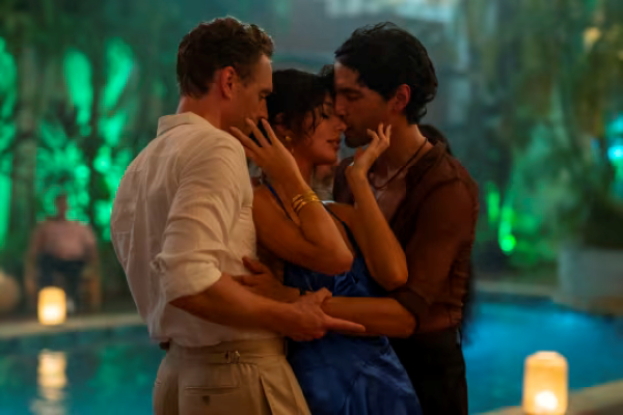
In other instances, this archetype is served up more subtly through nominally heterosexual characters who are nonetheless not averse to flirting (or going further) with men. Think Tom Hiddleston in the second season of The Night Manager, Leo Woodall in The White Lotus, or Luke Thompson in Bridgerton.
Meanwhile, in the project DTF St. Louis, David Harbour’s character, Floyd—a nominal straight man—clearly delights in the attention of a gay man on a casual date. Later, while dancing in their underwear with his best friend Clark (played by Jason Bateman), the two share helpless smiles, barely concealing their mutual attraction.
This on-screen sexual fluidity marks what Gay Times magazine recently dubbed the "Bisexual Renaissance." While cinema historically portrayed bisexuals as slippery villains (Loki in Loki) or deeply traumatized individuals (Caleb in Shameless), the new bisexual man is designed to charm and intrigue. Mass audiences are being fed the idea that bisexuals are so overflowing with raw sexual energy that they are ready to share it with anyone. And for a certain segment of society, this has become the new masculine ideal.
The Gen Z Trend
Bisexuality has become a foundational element of content tailored specifically to Zoomers.
For bisexuality, this is a fundamentally new status. For decades, sexologists and laypeople alike debated whether it even existed. One need look no further than Carrie Bradshaw in a cult episode of Sex and the City (2000), which today feels hopelessly outdated: "I'm not even sure bisexuality exists. I think it's just a layover on the way to Gaytown."
For a long time, many gay men viewed bisexuals as deceivers denying their true orientation, while heterosexuals saw them merely as opportunists trying to latch onto a trendy "alternative identity" without requiring any actual change in behavior.
Furthermore, while female bisexuality has historically been idealized (particularly by straight men), the notion that an outwardly masculine man might not be entirely heterosexual was traditionally perceived as a threat to the conventional patriarchal order.
Rewriting the Cinematic Code
To understand the scale of this shift, one only has to look at Luca Guadagnino’s Challengers (2024). It is a classic Hollywood setup of two guys vying for the attention of the same girl, who ultimately lock lips in a passionate scene initiated by her. Ten years ago, this moment would have been framed as a nightmare, a perversion, or a tragedy. Here, it is presented as a scorching throuple, underscored by feverish symbolic nods (a banana, churros) to the rivals' underlying mutual attraction.
Why has bisexuality exploded right now? Perhaps for heterosexual women, this archetype serves as a therapeutic fantasy protecting them from the toxic masculinity of the "manosphere"—much like Sharon Stone's character in Basic Instinct (1992) once reassured straight men intimidated by rising feminism.
Additionally, a subtle hint of bisexuality is an excellent way for a conservative Hollywood to look "woke" and relevant to younger demographics. Where a straight actor used to risk his career by taking on a gay role, playing with bisexuality today only raises his stock, making traditional male appeal more complex and alluring.
Demographic Reality vs. Labels
Ultimately, on-screen images may just be a reflection of dry statistics. Bisexuality is currently the fastest-growing sexual orientation in the world. The number of Americans identifying as such has tripled since the 1990s, with the figure rising faster among men than women.
Among Generation Z, LGBTQ+ identification rates have skyrocketed (22.3% among Zoomers compared to 2.3% among Baby Boomers), and this leap is driven precisely by bisexuals. Furthermore, among all adults who identify as part of the LGBTQ+ community, a majority (57.3%) now call themselves "bi."
Nearly 7% of Gen Z men openly identify as bisexual—more than double the proportion of those who call themselves exclusively gay. And that is without factoring in those who prefer more resonant terms like "pansexual" or "sexually fluid." A vast number of young guys today define themselves as "mostly straight," rejecting rigid boundaries.
Of course, there is nothing new about bisexuality—as any scholar of Ancient Greece will attest. "The world is not to be divided into sheep and goats," wrote Alfred Kinsey, author of the famous Kinsey Reports (and himself a bisexual), back in 1948. "Not all things are black nor all things white."
Nevertheless, the nature of male bisexuality remains deeply misunderstood in the public consciousness, argues Ritch Savin-Williams, professor emeritus of developmental psychology at Cornell University, who has dedicated decades to researching the topic. Incidentally, the professor defines himself as "completely gay" and has been married to a bisexual man for many years.
"Male sexuality is a spectrum. And bisexuality within that spectrum is not a monolith either," Savin-Williams explains. "It is rarely an equal attraction to both sexes. More often than not, the scale tips to one side. Or, for instance, a man might feel romantic attachment to one gender and purely sexual attraction to another."
On-screen narratives feed this interest, blurring the lines between identity and actual behavior. According to the Pew Research Center, 88% of bisexuals who are married or in long-term relationships are in traditional opposite-sex unions. The situation is further complicated by men who do not consider themselves bisexual but occasionally experience platonic or physical attraction to their own sex.
Generation Z navigates this fluidity with the greatest ease. Jean Twenge, author of Generations, notes that Zoomers have begun a mass rejection of labels altogether: "Their stance is: 'Yeah, I like this today, but tomorrow it could change.' And they view it as completely ordinary."
As for the fan base of bisexual characters on screen? It is growing by the day, uniting viewers of all genders and walks of life. Hollywood has struck gold—finding the ideal man who blends ruggedness, vulnerability, and an absolute freedom from prejudice.