Ice in Their Underwear and Air Kisses: How Paris Fashion Week Survived a Historic 105°F Heatwave
 19:30 27 June, 2026
Against the backdrop of the hottest day in France's recorded history, the fashion crowd switched to "air kisses" and hid ice cubes in their underwear. Designers stripped down models on the fly, while Rick Owens escaped the heat with Adidas-engineered built-in air conditioning, advising everyone to "stop being such pussies."
On Wednesday morning, as France officially recorded the hottest day in its history, Paris Fashion Week Men’s proceeded according to schedule. Well, almost.
The most coveted accessory during these days wasn't a new designer bag, a rare pair of sneakers, or a collectible timepiece. It was a bag of ice. As a historic heatwave slammed into the capital, turning the city into a scorching oven, luxury brands scrambled to save their guests from heatstroke.
The Dior show was originally scheduled for 2:30 p.m. in a grand, historic hôtel particulier near Parc Monceau. However, like practically every residence, bistro, office, and runway venue in Paris, the building has no air conditioning. A few days prior, as the extreme temperatures forced the Louvre and the Eiffel Tower to close early, Dior urgently moved the show to 9:00 a.m.
Upon arrival, guests were greeted by handsome waiters holding platters of strawberries, iced mocktails, and cold towels, while personalized, hand-engraved fans were placed on every seat. Yet, even at 9:00 a.m., thermometers were already reading 86°F (30°C), climbing rapidly toward a record high of 105°F (41°C). Major regions of the country were placed under a "red" weather alert, and hospitals prepared for an influx of heatstroke patients.
Official hospitality measures were clearly not enough, forcing the fashion elite to resort to pure DIY survival tactics.
Ice in Underwear, Amazon Group Chats, and "Bootleg" Fans
The heatwave laid bare a broader systemic issue for Paris: the city is struggling to host prestigious global events when its nineteenth-century architecture is completely unsuited to the new climate reality. "Paris Fashion Week is the canary in the coal mine," noted London-based critic Ben Freeman, who admitted he nearly fainted.
Backstage and in the streets, an atmosphere of raw survival prevailed. One designer admitted he didn't have AC in his apartment, so he had to "steal" fans from his own show's production set. Meanwhile, renowned street-style photographer Tommy Ton was dumping grocery-store bags of ice into his backpack: "The best part is just taking one ice cube and placing it into my underwear," Ton said. "By 10:30 a.m., I could see other photographers visibly bothered by the heat, so I let them lean against my backpack."
In industry group chats, instead of discussing the collections, attendees flooded threads with Amazon links and addresses of local shops that still had portable motorized fans in stock. James Harris, co-host of the popular Throwing Fits podcast, was spotted at a sushi restaurant around 9:00 p.m. wearing swim trunks and a cheap, horseshoe-shaped plastic collar fan around his neck: "It’s the bootleg version of the real thing, so I think there’s a 40 percent chance that it explodes and decapitates me, but anything helps at this point," Harris said.
The first definitive sign that the industry had entered unprecedented territory was the universal abandonment of the traditional French cheek-kiss greeting. Instead, it was replaced by awkward, apologetic "air kisses" blown from a distance. Structured suits and loafers were instantly tossed out of wardrobes. "Everyone ditched their suits and loafers for shorts, tank tops, and sandals," shared Nick Tran, head buyer at Dover Street Market Paris. "There are way more shorts—lots of short-shorts."
The Runway Adapts on the Fly
The extreme weather forced designers to aggressively rethink their styling choices hours before the models hit the runway. Shortly before the Dries Van Noten show at a 16th Arrondissement tennis club on Thursday, the brand's publicists texted a warning to guests: "Please don't arrive early. It might be quite warm inside."
Outside, it was nearly 100°F (38°C). Inside, production assistants tried to salvage the situation with hand fans, cold beers, popsicles, and facial misting stations. Ultimately, the true refreshment came from the collection itself. The brand presented a skin-baring, incredibly light collection: silky, backless camisoles, gossamer sheer blouses, unlined parkas rippling in the hot air from industrial box fans, and an abundance of flip-flops and ballet flats. When designer Julian Klausner took his bow, the weary, sweaty crowd roared with an intensity unmatched all week. "We started this season with the desire to do something light and airy and delicate," Klausner admitted backstage. "And of course, in the last few days, we stripped it back a little bit—removed some tops and went more with the shorts."
At Dior, Jonathan Anderson presented structureless, semi-translucent suits that seemed to float entirely off the models' bodies. "This calendar makes no sense," Anderson lamented, criticizing the industry for forcing summer collections to show in suffocating heatwaves and winter collections in freezing temperatures.
Anthony Vaccarello, marking his 10th anniversary at Saint Laurent, similarly stripped back his signature muscular tailoring silhouette. He sent models walking through cooling clouds of mist generated by a Fujiko Nakaya fog sculpture. Even so, the brand leaned into contrast: ultra-light fabrics were paired with leather shorts, heavy choker scarves, and see-through plastic dress shoes that visibly fogged up from the models' sweat right before the audience's eyes.
The garments on the Parisian runways today are no longer being designed for a traditional European summer. They are engineered for a global market—for clients who spend their hottest months in the heavily air-conditioned microclimates of Middle Eastern mega-malls or high-rises in New York and Shanghai. For them, a fur coat or a neoprene wetsuit (as seen at Louis Vuitton) in June isn't madness; it’s simply a luxury purchase.
Rick Owens: "Stop Being Such Pussies"
The only person who seemed entirely unperturbed by the climate catastrophe was Rick Owens. On Thursday morning, in the courtyard of the Palais de Tokyo—where the sun was practically baking the concrete—Owens stood in a paper-thin tank top without a single drop of sweat on his brow. "Everybody’s just a little hot. Stop being such pussies. It’ll be fine!" he declared.
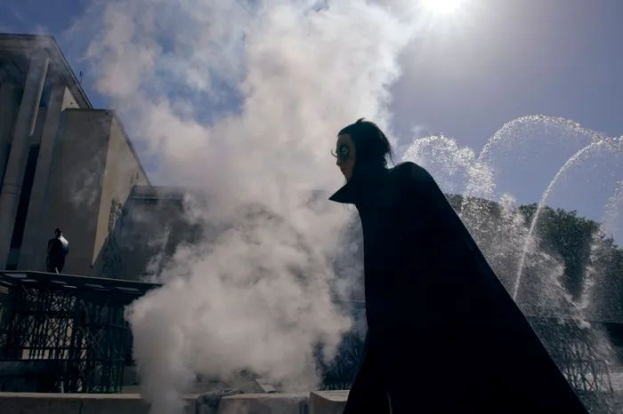
Nevertheless, the designer took the forecast seriously and, like Dior, moved his show to the morning. It was staged on a catwalk suspended over the museum’s reflecting pool. Giant jets of water arced into the sky, misting the crowd with a cool haze as models marched to hardcore techno in sharply cut black blazers and tight leather.
The sweltering audience looked on with pure envy at a series of bulbous, Michelin Man-style tracksuits created in collaboration with Adidas. The garments were inflated from the inside by internal miniature fans. Owens had borrowed Adidas's proprietary Climacool system, providing his models with a personalized, air-conditioned microclimate. "Very timely, isn’t it?" Owens smirked. He titled the collection Stone. "I’m getting older, so I’m thinking, how do I do this gracefully moving forward?"
Before heading backstage for final touch-ups, Owens offered a message that, within his dark fashion universe, passes for hopeful: "This planet has survived worse, or maybe it won’t survive. But death is part of life. So we’re going to die, maybe the planet’s going to die, our race is going to die, and something else is going to happen."
The Cultural Taboo of Air Conditioning
In France, artificial cooling remains a deeply contentious issue. Air conditioning is historically unpopular; it is frequently blamed for colds, viewed as an eco-destructive luxury, and seen as a waste of energy. Emmanuel Macron’s government has instead prioritized architectural insulation, shade canopies, and urban tree-planting. Environmentalists continuously warn that widespread AC installation will only accelerate global warming due to the resulting surge in carbon emissions.
Yet, Europe is the fastest-warming continent on Earth. Its entire infrastructure—from sports to tourism and fashion—is structurally anchored to rigid seasonal calendars and massive outdoor events. Now, these industries are being forced to mutate in real-time.
The defining question moving forward is simple: how much longer can a nineteenth-century city like Paris continue to host the world's premier summer fashion spectacle, when guests can no longer make it to the finale without a bag of ice tucked into their underwear?
Based on reporting by AP and The Cut