£80,000 a Night on Wheels: What the Most Secret and Luxurious Train Carriage in the World Looks Like
 16:32 17 August, 2026
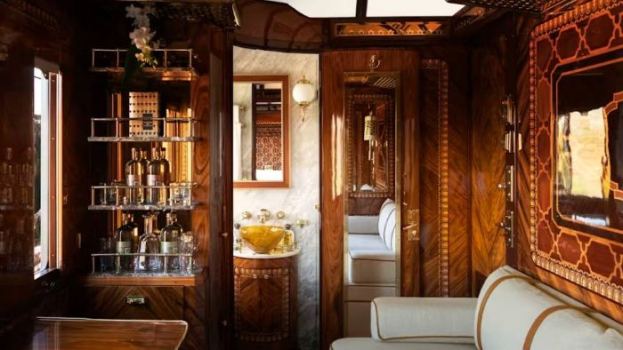
Somewhere between Paris and Venice, a train now runs with a secret tearoom. Not just a nook you might stumble upon by accident, but a carefully concealed space where finding it becomes part of the entertainment. This is L’Observatoire, a new exclusive suite introduced by the Venice Simplon-Orient-Express in collaboration with artist JR. An entire train carriage booked for just one couple for a single night costs around £80,000.
A Dream Carriage for Those Who Can Afford Everything
Guests have at their disposal a freestanding bathtub, a library with hundreds of books, and a special ceiling oculus for stargazing (because at some point, why not). It is a stunningly luxurious project, and if you can afford such a night, it costs roughly the price of a small apartment in Genoa. Unlike the apartment, the carriage comes with a personal steward and unlimited champagne—though only for one night.

Yet more interestingly, this idea itself runs much deeper than JR's artwork, the Belmond company, or the legendary Orient Express itself.
Monarchs Did It First
For much of the 19th century, a private train for a king, archduke, or ambitious prince was not an excess, but a standard element of status—much like a coat of arms. Queen Victoria set the trend in 1842, becoming the first British monarch to travel by rail. She acted in the most monarchical way possible: she challenged the engineers' calculations and personally limited her train's speed to forty miles per hour by day and thirty by night, deeming that pace the most comfortable.

Austrian Emperor Franz Joseph went even further, traveling in his own imperial train across Austria-Hungary—Bosnia one season, Galicia the next. The emperor's presence in his own carriage helped hold a crumbling empire together.
Passing the Torch: From the British Crown to the Orient Express
The irony of fate is that the UK's own Royal Train—a direct descendant of Queen Victoria's carriages—is retiring in 2027. King Charles III, for reasons of economy, decided to abandon the upkeep of the private train in favor of helicopters. For two centuries, sovereigns crisscrossed Europe in personal carriages, and now the institution that started this tradition is quietly closing its hangar.

Meanwhile, artist JR, who spent his youth doing graffiti on trains, built a hidden tearoom on wheels, and people are lining up to pay handsomely for a night in it. There is a special irony in this: an idea that previously required inheriting a throne now requires nothing more than a good line of credit.
Is It Worth Booking?
If you have the means and the occasion—absolutely. It is genuinely an unusual way to spend a night, crafted by the labor of a hundred artisans, with real marble and attention to detail on one of the last trains in the world where romance still survives.

Not everyone is ready to spend that kind of money, and that is fine. The rest can enjoy standard cabins a few carriages down, look out at the exact same Alpine landscapes for a fraction of the cost, and feel the quiet satisfaction of knowing someone behind the door of the secret tearoom is keeping a two-hundred-year-old tradition alive in their own way. After all, even Franz Joseph would likely approve of that ceiling oculus.