Billionaires Want to Hear the Engine Roar: Bugatti Chief on the Unexpected Future of Supercars
 22:17 31 August, 2026
As the global auto industry races toward an electric future, Bugatti CEO Mate Rimac is convinced that at the very top end of the market, the future belongs not to silent EVs but to powerful internal-combustion engines.
The 38-year-old entrepreneur, who took the helm of Bugatti in 2021, believes the automotive market will split into two very different worlds. The mass market will increasingly move toward affordable electric vehicles, many of them made by Chinese manufacturers. But buyers of the most expensive sports cars will want something entirely different: roaring engines, intricate mechanics, craftsmanship and emotion.
Rimac compares the shift to what has been happening in the watch industry for years.
“For normal cars, for normal people, the vast majority of cars will be electric,” he told CNBC. “But the upper end, starting with sports cars, will remain internal-combustion for a very long time. Just like watches.”
According to Rimac, only around 5% of watches are manufactured in Switzerland, yet they account for roughly 90% of the industry’s profits.
“An Apple Watch or any other smartwatch can do much more. But nobody is going to pay $200,000 for one,” he said.
Bugatti Went Against the Trend
The irony is hard to miss: Rimac himself leads a company that could have become one of the most prominent symbols of the supercar industry’s transition to electric power.
After Rimac Group took control of Bugatti from Porsche and Volkswagen in 2021, many expected the arrival of a fully electric Bugatti.
Instead, the opposite happened.
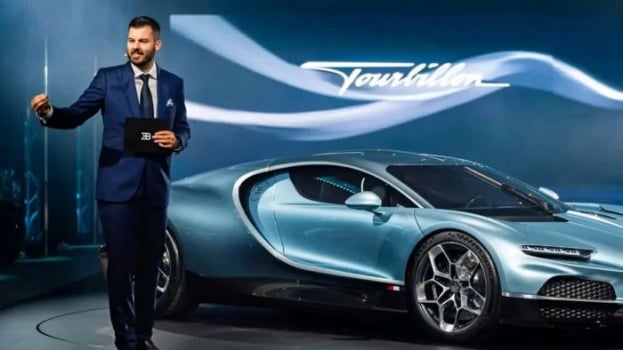
The company created Tourbillon — an entirely new hypercar powered by one of the largest naturally aspirated internal-combustion engines ever fitted to a production car.
At its heart is a massive 8.3-liter V16 producing 1,000 horsepower. Combined with electric motors, the hybrid powertrain delivers an astonishing 1,800 horsepower.
“It’s quite ironic that I’m now creating the world’s biggest internal-combustion engine,” Rimac admitted.
According to the executive, the Bugatti Rimac factory in Croatia now presents an almost surreal sight: on the same production line, the world’s most powerful electric car and the world’s largest internal-combustion engine are being assembled side by side.
“Sometimes life is strange,” Rimac observed.
$4.5 Million — And That’s Just the Beginning
Bugatti will produce just 250 examples of the Tourbillon, and every one has already been sold.
The starting price is around $4.5 million.
But for Bugatti customers, that is far from the final bill. According to Rimac, the average buyer spends another $600,000 to $700,000 on personalization.
That can include exclusive exterior colors, special types of leather, bespoke stitching and other details that transform each hypercar into an almost entirely unique creation.
Customization has become one of the most lucrative sources of revenue for makers of ultra-expensive cars, including Bugatti, Ferrari and Lamborghini.
Increasingly, manufacturers are also creating one-off cars specifically for their wealthiest clients. Prices for such bespoke machines can reach tens of millions of dollars.
During Monterey Car Week, Bugatti unveiled another unique creation — Destrier, a reimagined version of the track-focused Bolide featuring a lower stance, larger wheels and a sculptural body.
Billionaires No Longer Want Just a Fast Car
According to Rimac, the world’s wealthiest customers are no longer buying cars simply as means of transportation. They are buying an extension of their own identities.
“These clients want something that is really theirs, something that is connected specifically to them,” he explained. “It tells their story, reflects their character and their preferences. It’s no longer just a car. There is a whole story behind it.”
That is why, Rimac believes, raw performance is gradually becoming less important in the world of supercars.
The paradox of today’s market is that astonishing performance can now be obtained for far less money.
“In China today, for around $50,000, you can buy a car that is faster than any sports car from 10 years ago,” he said.
That means wealthy buyers have to be offered something more.
Art That Can Accelerate to 400 km/h
In an era of artificial intelligence, autonomous vehicles and electrification, Bugatti intends to focus on what Rimac calls the human factor.
“Performance really is becoming secondary,” he believes.
What is taking center stage instead is craftsmanship, engineering ingenuity, artistry and beauty.
“When you look at these cars, you see the amount of ingenuity, art and beauty that has gone into them,” Rimac said.
In his view, a car remains one of the most complex objects a person can buy.
It is simultaneously a work of art and a high-tech machine capable of reaching 400 km/h, maintaining stability at extreme speeds, passing stringent crash tests, operating in snow and enduring extreme heat.
“I want to create the best cars in the world, the most exciting cars in the world — and make Bugatti the most profitable automotive company in terms of margins.”
And if Rimac is right, the future of the supercar will be wonderfully paradoxical: the mass-market automobile will become electric and increasingly digital, while the most coveted car for a billionaire will remain loud, mechanical and almost theatrically analog.