Medieval tapestry packed with phalluses hides sex scandal that could rewrite European history
 16:55 2 September, 2026
A centuries-old piece of adult-themed artwork depicting a pivotal moment in England’s past could completely change our understanding of British history — all because of what appears to be a sordid royal affair, according to the New York Post.
The famous Bayeux Tapestry, which recently returned to Britain for the first time in nearly 1,000 years after spending centuries in French Normandy, depicts 58 events leading up to the Battle of Hastings and the Norman Conquest of England in 1066.
Those pivotal events transformed the country’s ruling class, shifted its national language from English toward French and forever intertwined the fates of England and France.
The masterpiece is also notorious for its abundance of phalluses, with experts counting between 93 and 94 of them. They could represent anything from ordinary medieval graffiti to a form of hidden satire aimed at some of the most powerful figures of the era.
But that is far from the most scandalous image woven into this medieval equivalent of the tabloids.
Hidden among the tapestry’s threads is a scene that may have threatened the legitimacy of the very man who conquered England — William the Conqueror, Duke of Normandy.
“It undermines the legitimacy of the Norman Conquest,” British Museum curator Michael Lewis said while discussing the alleged medieval pamphlet on the HistoryExtra podcast.
The secret affair that threatened a throne
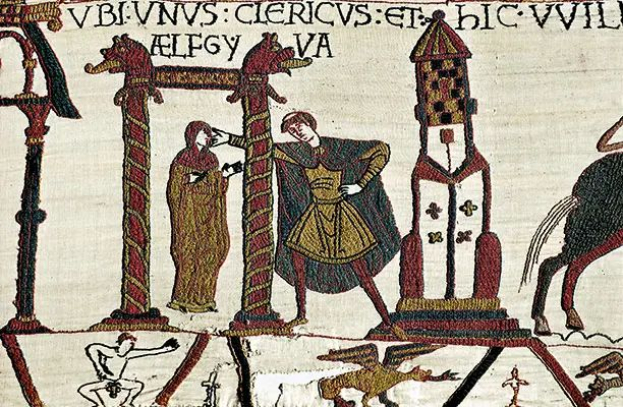
The controversial scene depicts a cleric gently touching the cheek of a noblewoman named Aelfgiva, while a naked man watches them from beneath the decorative border.
According to Lewis, the mysterious woman may actually be Emma of Normandy — the wife of English King Æthelred the Unready and the mother of Edward the Confessor.
Emma, who adopted the English name Aelfgiva after her marriage, was William the Conqueror’s great-aunt. When Edward the Confessor died childless, William used their family connection to support his claim to the English throne and ultimately pave the way for his invasion and conquest of the country.
But persistent rumors circulated at the time that Emma had been unfaithful to King Æthelred with a powerful churchman.
Lewis believes the scene on the tapestry may allude to that alleged relationship, potentially casting doubt on William’s dynastic claim to the crown.
“The accusation against Emma was that she was having an affair with Ælfwine, the Bishop of Winchester,” the curator explained. “This [naked] figure underneath, and this whole sexual scandal, completely turns the story against her.”
If Lewis’s theory is correct, the medieval insinuation could have seriously undermined the dynastic legitimacy on which William based his claim to the English throne.
Of course, the woman’s exact identity on the tapestry remains a matter of debate.
The mystery is complicated by the fact that the name Aelfgiva was extremely common in 11th-century England.
Historians have proposed other possibilities as well. She could have been Æthelred’s first wife, Ælfgifu of York, or Ælfgifu of Northampton, the wife of Danish King Cnut the Great, whom the widowed Emma later married.