Luxury Is Getting Cheaper on the Stock Market: Why LVMH and Prada Now Trade at Nearly Mass-Market Valuations
 21:33 6 October, 2026
Not long ago, shares of luxury companies were considered some of the most attractive investments on the market. Today, the picture is changing. Shares of LVMH, the owner of Louis Vuitton, and Prada are trading at unusually steep discounts to mass-market companies such as Zara and H&M. And investors are in no rush to take advantage of the lower prices, worried that the best days for the luxury industry may be behind it, The Wall Street Journal reports.
Global luxury sales have barely grown for three years. The key question for the industry is whether the current downturn is temporary or reflects more fundamental changes. Two forces that fueled the luxury market’s rapid growth over the past 20 years — surging demand in China and the expanding Western middle class willing to spend on high-end goods — are gradually losing momentum.
That means the industry’s familiar growth rate of around 8% a year could soon become a thing of the past.
China Is No Longer Saving Luxury
Chinese consumers have accounted for more than half of the global luxury industry’s growth over the past 30 years. But the financial position of Chinese households now looks far weaker than official economic indicators might suggest.
Chinese consumers are drawing down their savings, yet this is not translating into stronger retail sales. According to research and brokerage firm Bernstein, retail sales have grown by less than 1% for five consecutive months. This could indicate that households are using their savings not for major purchases, but increasingly to cover everyday expenses.
The property market is making matters worse. Although home prices have stabilized in major cities such as Beijing, they continue to fall in the regions where around 90% of the population lives. Overall, Chinese property values have dropped by roughly 40% from their late-2021 peak.
Against this backdrop, homeowners feel poorer and are cutting back on luxury spending.
Another potential factor is a new tax. In the summer, Beijing announced a 20% tax on offshore trusts owned by Chinese citizens. A decline in sales at luxury shopping malls in July could be an early sign that wealthy Chinese consumers are already beginning to postpone major purchases in anticipation of substantial tax bills.
The Middle Class Is Cutting Back, Too
The problems are not confined to China. Middle-class consumers in Europe and the United States also have less disposable income.
A new wave of inflation, rising energy prices amid the war with Iran and higher government bond yields are driving up the cost of living and borrowing. Consumers are paying more for mortgages and car loans, leaving less money for $4,000 handbags and other luxury purchases.
As a result, luxury brands are becoming increasingly dependent on a relatively small group of ultra-wealthy customers who continue to spend heavily.
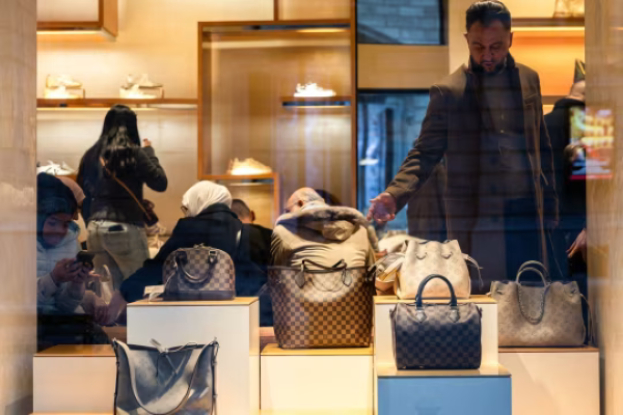
For companies such as Brunello Cucinelli, which already cater primarily to affluent consumers, this is not necessarily a problem. Louis Vuitton, however, operates under a different model: more than half of its sales come from middle-income consumers. Each customer may make relatively modest purchases, but it is this broad customer base that generates the brand’s enormous sales volumes.
LVMH No Longer Looks Like an Obvious Bet
This helps explain investors’ caution toward LVMH and Prada, even though their shares look cheap by historical standards.
Based on expected earnings, LVMH is trading at roughly a 30% discount to Inditex, the Spanish company that owns Zara. The last time the gap was this wide was in 2016.
LVMH was also experiencing a slowdown in sales at the time. Consumers had grown tired of heavily logoed handbags, while conspicuous luxury had become particularly risky in China.
But the company managed to reshape its product mix, and Chinese demand eventually recovered. After 2020, LVMH also expanded its presence in the United States. An investor who bought LVMH shares at the beginning of 2016 and held them for five years earned an average annual return of around 34%, including reinvested dividends.
Today, the outlook is far less clear-cut.
Luxury brands are having to compete not only with one another but also with the resale market. According to Morgan Stanley, that is a major difference from the situation a decade ago. For example, sales at resale platform The RealReal rose 17% in the second quarter.
The stock market is effectively signaling that more affordable companies such as H&M and Zara could benefit from the shift: former luxury shoppers may be moving toward more accessible brands.
Cartier Has a Different Strategy
Richemont, the owner of Cartier, is in a somewhat stronger position. Its shares currently trade at roughly the same valuation multiple as Inditex.
Cartier’s sales are growing thanks to the brand’s ability to attract customers across a broad range of income levels — and that could prove crucial in what is known as a K-shaped economy, where the financial fortunes of different groups are increasingly diverging.
Cartier prices start at a few hundred dollars for a simple ring and can reach $10 million or more for one-of-a-kind, bespoke creations.
Luxury Will Have to Choose
The luxury industry now faces a difficult choice: make its products more accessible or preserve high prices while accepting a contraction in its business.
Either way, luxury stocks are becoming a very different investment proposition from what they were in the past. Investors can no longer automatically count on high growth rates, enormous operating profits and brands’ seemingly limitless ability to raise prices.
Against this backdrop, social media is increasingly debating a fundamental question: are luxury goods really still worth the money?
Judging by the behavior of the stock market, investors are beginning to have serious doubts as well.