At the Crossroads of Ambition and Commerce: A Look at Yerevan Fashion Week 2026 Against the Backdrop of Global Fashion
 20:30 15 October, 2026
The fourth edition of Yerevan Fashion Week has come to a close, leaving behind hundreds of glossy social media images and a noticeable footprint in both local and international press. The Pink City concept, a spectacular opening at the Erebuni Fortress, international guests and representatives of fashion publications — all contributed to the event’s high-profile image. Yet behind the polished visuals lies a more practical question: what does Armenian fashion represent today? How independent is it, where has it genuinely moved forward, and in which areas does it continue to follow established international trends?
Global fashion, meanwhile, is undergoing a period of significant change. Designers are rethinking familiar silhouettes, experimenting with materials, returning to craftsmanship and searching for new ways to reconcile artistic expression with commercial demands. Against this backdrop, Yerevan Fashion Week presented a mixed picture: plenty of promising ideas, but not always the execution to match.
Global Fashion in 2026: Between Practicality and Experimentation
The Spring/Summer 2027 fashion weeks demonstrated that the industry no longer has a single dress code. Sheer fabrics share the runway with restraint, minimalism clashes with maximalism, and everyday dressing flirts with outright theatricality.
London embraced boudoir aesthetics: lace, layers of translucent fabric, sporty inserts and handwork that invites closer inspection. Milan gave the skirt the starring role, allowing it to take virtually any form. Miuccia Prada built her season around knee-length skirts, while lingerie became a complete look in its own right. Paris moved decisively away from minimalism, embracing bold colors, statement footwear and prints with personality. Commercial considerations occupied the front row at every show: even the most daring runway presentations featured pieces a client could imagine in her own wardrobe.
The season’s defining story resembles a successful vintage resale find: nothing fundamentally new, but everything presented with a different fit. Lingerie tops, skirts, sheer dresses, embroidery and lace returned in fresh proportions and unexpected combinations. There was also a renewed appetite for character: deliberately “wrong” pairings, prints that clash with one another and accessories with a point of view.
Against this backdrop, the Yerevan runway did not look as though it had arrived from another planet. Lingerie-inspired silhouettes, lavish embellishment and dramatic styling were all present, echoing the season’s dominant vocabulary. And there is nothing wrong with that. Fashion has always been a collective art form, and borrowing a trend does not automatically make a designer derivative. What does is the absence of an idea.
There is, however, a nuance here, and it concerns timing. While the global conversation is moving away from minimalism, Yerevan’s commercial ready-to-wear segment remains firmly within its territory: sleek mini dresses, satin and slip silhouettes. This is my observation, not a statistical finding, but the gap feels roughly equivalent to one fashion season. We are in step with global trends, but we are not yet getting ahead of them or setting the agenda.
Commercial Ready-to-Wear
The main protagonist of the week was commercial ready-to-wear. Evening dresses that speak for themselves, lingerie-inspired styling, minimalist minis and silhouettes that require no instruction manual.
The logic is understandable. Local brands operate in a relatively small market, and producing a collection requires a substantial investment. Clothes have to sell, production costs have to be recouped, and designers need to understand their customers. Expecting every participant to present a conceptual manifesto would mean ignoring how the industry actually works.
But wearability has its limits. Thin-strapped slip dresses, satin styles and simple minis have become timeless classics because of their versatility. Yet when lingerie-as-outerwear appears on runways around the world, getting the trend right is no longer enough. A designer needs a signature of their own, expressed through cut, proportions, texture or an unexpected combination of materials.
SUMARA’s show could serve as a textbook example of how a local brand can speak the language of major European fashion houses. This is neither a couture experiment nor a claim to be one. What it demonstrates instead is a skill valued by everyone from Ralph Lauren to an ideal production studio: the ability to create clothing that looks expensive, feels cohesive and speaks directly to its target customer. A recognizable aesthetic, carefully calibrated styling and commercial appeal. Not every collection needs a manifesto. Business thrives on those who know how to sell beautifully.
The next step for SUMARA and the wider segment is learning to put their own signature on their work. Adapting a trend intelligently and saying something of your own are two different skills. Yerevan’s fashion scene has mastered the first with confidence. The second still requires work.
Déjà Vu Syndrome
One thought surfaced more often than any other: “Haven’t we seen this somewhere before?” The local scene continues to oscillate between restrained commercial femininity and dark streetwear infused with gothic references and deconstruction. Both camps have a place and an audience. But when the same devices migrate from one season to the next like an old suitcase without a luggage tag, it is time to ask whether they represent a designer’s distinctive language or simply a formula that worked once.
SONČESS brought terracotta and burgundy jackets, pleated crop tops, finely checked trousers and loose-fitting gray dresses to Erebuni. The color palette worked, the aesthetic was coherent, and the pieces had clear commercial potential. Armenian identity appeared on the runway through motifs reminiscent of carpet patterns and dried flowers incorporated into accessories. But when national identity exists only in the decoration, the result is a picture-postcard version of heritage: charming, recognizable and superficial. The motif embellishes an existing construction rather than defining its architecture.
This is where the line between quotation and reinterpretation lies. Quotation attaches an ornament. Reinterpretation asks how the proportions of a traditional garment, a craft technique or the logic of a material can transform a contemporary cut.
Another issue is the use of techniques that have remained on international runways for several seasons. Oversized flowers made of sheer organza lend theatricality to a look, and the trend has not lost its relevance. When floral elements are integrated into a garment’s construction, interact with the fabric and reshape the silhouette, they become design. When flowers are simply pinned onto a familiar dress like brooches, we are looking at a reprise.
Armenian designers do not need to apologize for drawing on global trends. They simply need to avoid using those trends to answer every creative question.
National Identity: From Ornament to Architecture
Armenian fashion has one of the region’s richest cultural wardrobes to draw upon: historical dress, textile traditions, carpet-making, embroidery, jewelry craftsmanship and architectural heritage. But a rich archive will not make a garment by itself. It has to be translated.
The opening at Erebuni Fortress and the project Ancient Gods: From Erebuni to Contemporary Yerevan offered a compelling starting point. Revisiting ancient history and retelling it through contemporary silhouettes is an idea with considerable potential. The essential next step is to translate historical imagery and craft principles into the language of modern clothing.
In many collections, however, identity is still communicated through decoration: ornamental patterns, floral motifs and accessories with ethnic associations. The reference is immediately recognizable, but it does not change the garment itself. Working with heritage can go much deeper: rethinking the proportions of traditional dress, developing a new logic of layering, exploring textures and hand-finishing, using local materials and reinterpreting historical techniques for contemporary design.
This is the kind of approach associated with Alexander McQueen, who turned Scottish kilts into a statement, and Martin Margiela, for whom form consistently mattered more than labels. National identity does not have to be literal. Sometimes it is embedded in the architecture of a garment: how it is constructed, how it moves on the body and how it rewrites our understanding of silhouette.
This year’s Tbilisi Fashion Week offered a practical illustration of what such an approach can look like. Craftsmanship took center stage in a literal sense: artisans worked at a live loom near the entrance, while designers addressed censorship, migration and identity through their collections. For Yerevan, it was a mirror. Our material is no less rich; what we need is a more sophisticated translation of it.
Commerce and Avant-Garde: Two Poles of the Same Fashion Scene
If ready-to-wear answers to the market, experimental projects answer to art. This season offered examples of both, ranging from theatrical looks to complex conceptual constructions.
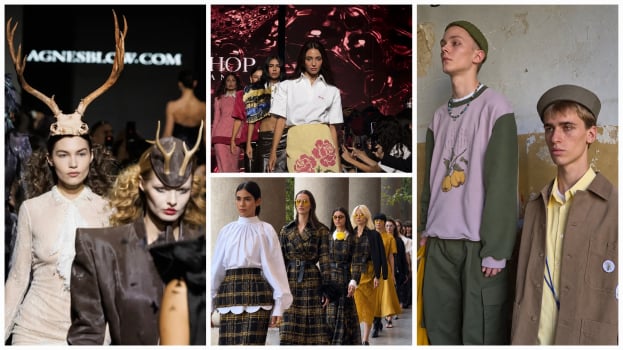
Agnes Blow opted for maximum intensity. White looks with angelic symbolism, latex, leather, horns, feathers, elaborate lace structures and deconstructed bridal silhouettes. Such a statement commands attention and photographs beautifully on the runway. But provocation is not the same as depth: the louder the gesture, the greater the demands on cut, proportions and execution. In several looks, the theatrical concept proved more convincing than the technique, while styling took precedence over form.
Comparisons with Alexander McQueen and John Galliano are almost inevitable: provocation, historical references and the dramatization of the body. But for those designers, shock value was only the outer layer of a complex system built on construction, proportions, materials and runway direction. Theatricality could become a signature of Yerevan’s fashion scene, but simply adding feathers, latex or a provocative accessory to a familiar silhouette is not enough. The idea must shape everything, from the patterns used to construct the garment to the final beam of light on the runway.
At the opposite end of the spectrum was the MADE-VEL-E × FCA collaboration and its Eyes-Wired-Shot collection. The project relied on conceptual thinking, complex styling and an exploration of volume. Models appeared with their eyes concealed beneath oversized headpieces made from straw, fabric and decorative elements. The face ceased to be the focal point, allowing the clothing to become the main character.
Several looks stood out: a rigid A-line dress with a texture reminiscent of stone or an ancient fresco; a voluminous pastel cape adorned with textile flowers and handmade beads; and a red deconstructed look featuring a complex upper construction and a skirt with deliberately frayed edges. Here, it was not a single detail that carried the collection but the overall composition: fabric texture, headpiece volume, silhouette proportions and surface treatments all served a unified visual direction. Eyes-Wired-Shot proposed its own visual system, something missing from collections built around familiar commercial forms.
Projects like these look particularly promising. The avant-garde does not compete with commerce on its own terms; instead, it allows us to see the designer as an author beyond the trends. One distinction is important, however: a conceptual collection is not automatically haute couture. The avant-garde and Haute Couture operate in different categories. But as an example of creative exploration, with an interest in form, texture and the body rather than a retelling of familiar ideas, this work deserves attention.
This is why Yerevan’s fashion scene needs both poles. Commerce sustains brands and allows them to grow; experimentation expands their vocabulary. Problems arise when commercial safety becomes the only criterion, or when the idea itself takes precedence over the quality of execution.
From Showcasing to Building a Distinctive Fashion Identity
Yerevan Fashion Week 2026 demonstrated that Armenian fashion has the potential to compete on the international stage. The organizers are building relationships with international industry professionals, creating opportunities for emerging designers and gradually developing a platform where commerce, culture and experimentation intersect.
The shows varied considerably. Some prioritized wearability and an expensive-looking aesthetic, others embraced theatricality, while others focused on form, texture and conceptual styling. It would be unfair to dismiss the entire week as a repetition of global trends: Yerevan’s runway displayed both commercial competence and a willingness to take risks.
Yet outward polish still outpaces creative independence. Ready-to-wear dominates, some brands repeat familiar solutions, and national identity is often reduced to decoration. Conceptual projects still need to demonstrate that their ideas are matched by an equally high standard of execution. For now, we are a promising newcomer worth watching, but one whose work is still too early to cite as a reference point.
Liana Aghajanyan
Photo: Ernest Avetisyan, Yerevan Fashion Week/Instagram