Horns vs. the Cross, Young People vs. Adults: How Halloween in Armenia Became a Generational Battleground
 22:31 26 October, 2026
Righteous indignation or boring adults? Cringey kids or harmless fun? While some people put on horns and fake fangs, others remind them of Christian values and national identity. So why can a few costumes and jack-o’-lanterns turn an ordinary October evening into a debate over what Armenia should be?
Ten Years of the Devil Roaming Northern Avenue
For a decade now, October 31 has turned Northern Avenue into an impromptu runway for witches, vampires, anime characters and heroes from popular TV shows. Some people spend hours putting together their looks, while others settle for black eyeliner and a pair of plastic fangs. Young people take photos, shoot videos and head to themed parties. For some, it is a long-awaited carnival. For others, it is yet another sign that young people have become too enamored with foreign traditions.
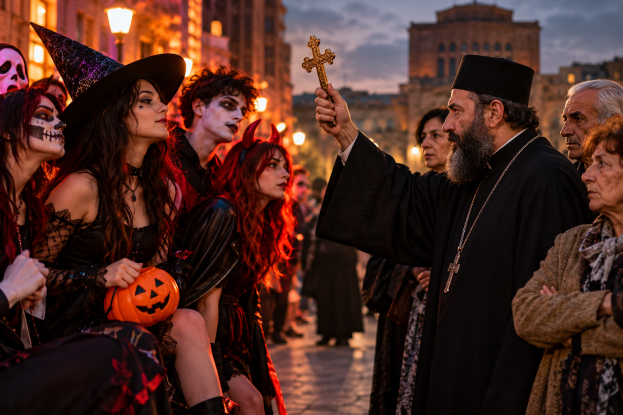
But alongside the parade of costumes, another spectacle unfolds. Opponents of Halloween take to the streets to explain to passersby why the holiday is incompatible with Christian values. In 2025, a group of Christians did indeed hold a protest against Halloween celebrations in central Yerevan. Some participants spoke about creativity and entertainment, while others urged young people to remain faithful to religious traditions.
Satanists in Children’s Costumes
In Armenia’s Reddit community, the Halloween debate has long since moved beyond parties. Users argue about religion, cultural identity, Western influence and the right to decide for oneself what counts as entertainment.
In one thread published on October 31, 2025, a user complained that people had increasingly been scolded in recent years for wearing “satanic” costumes, both children and adults alike. Another user described seeing a video of a man berating children in costume before shaming their parents for allowing them to dress up that way.
Perhaps most unexpectedly, one of Halloween’s defenders identified himself as a devout Orthodox Christian and a future deacon. Wearing a costume, he argued, does not in itself indicate an attachment to demonic ideas. A child dressed as a character from a movie or cartoon is not taking part in any kind of mystical ritual.
The argument is simple, but simple explanations rarely go far in the Halloween debate. For some, the holiday plays with images of death, fear and the supernatural. For others, it is an opportunity to spend an evening being anyone other than their usual selves. Someone dressed as a vampire does not endorse everything vampires do in movies, just as a horror movie fan does not dream of spending the weekend with a real-life serial killer.
It would be too easy to dismiss every objection as a lack of humor. Symbols matter to believers, and the origins and meaning of traditions are legitimate subjects for serious discussion. People have every right to abstain from the holiday and explain their position.
The situation changes, however, when conviction turns into an attempt to shame an unfamiliar teenager on the street. At that point, the conversation is no longer about faith but about the boundaries of someone else’s freedom. Approaching another person’s child, criticizing their appearance and then reprimanding their parents may be possible, but it says more about certain adults’ belief that they have the right to discipline those around them than it does about Halloween itself.
The World’s First Christian Nation Is Afraid of Plastic Fangs
The main argument made by Halloween’s opponents in Armenian discussions goes something like this: Armenia was the first country in the world to adopt Christianity as a state religion, so why embrace Western holidays with no roots in Armenian culture?
The Church has addressed the issue before. In 2013, Father Babken Hayrapetyan of the Ararat Diocese described Halloween as a foreign phenomenon with no connection to Armenian roots and suggested that people turn their attention to Maslenitsa, the traditional festivities before Lent. In 2024, Father Ter Shmavon Gevondyan of Yerevan’s St. Hakob Church said Halloween traditions contradicted biblical teachings and suggested that parents introduce their children to biblical stories and religious imagery instead.
This position is understandable. In a country with a strong Christian tradition, religion has long been more than a matter of personal faith. It is intertwined with historical memory, family customs and ideas about national identity. For some people, then, the debate is not about pumpkins and makeup but about what Armenian society is willing to adopt from other cultures.
But Armenian identity does not have to exist in isolation. Young people watch American TV shows, listen to Korean music, buy clothes from international brands and celebrate holidays they discover on social media. Global culture does not ask permission before crossing borders.
Halloween can be disliked, dismissed as commercial, foreign or meaningless. But an interest in Western pop culture does not automatically mean abandoning one’s roots. A witch costume does not erase the Armenian language, family history or religious beliefs. The question remains: why is cultural openness so often perceived as a threat?
Adults Pray, Kids Post
On social media, the debate quickly takes on the familiar shape of a generational conflict. Adults talk about spirituality, while young people respond with memes. Some see Halloween as a dangerous set of symbols; others see an excuse to wear a ridiculous wig, try dramatic makeup and spend an evening with friends. Both sides accuse the other of lacking common sense.
One Reddit user summed up the annual scenario this way: first, some people organize protests, while others do their makeup to look cool, and then everyone goes off to eat shawarma and sleep. Until next October, that is.
There is an astute observation in that joke. For most people taking part in Yerevan’s Halloween celebrations, the stakes are much lower than the online arguments suggest. They are not planning to change their religion, rethink their national identity or join a secret society. They simply want an unusual evening.
The results, of course, can be questionable. Not every makeup look deserves its own post, not every costume inspires admiration, and some parties look more like competitions over who can use the most fake blood. But bad taste has never been sufficient grounds for a public trial. Adults watch horror movies, dress up for themed parties and buy things other people might find ridiculous, too. The difference is that adults can more easily call it personal choice, while teenagers often have to sit through a lecture on morality first.
Critics of Western influence raise another question worth considering separately: young people are quick to embrace foreign traditions but know less about their own. Armenian festive culture is indeed rich in rituals, masks and carnival elements. One example is Bun Barekendan, a traditional celebration held before Lent, featuring merrymaking, costumes and folk festivities. Yet today, not every young person in Yerevan could explain how it is celebrated.
Back in 2012, ethnographer Hranuş Kharatyan, commenting to ARMENPRESS on young people’s interest in Halloween, linked the holiday’s popularity to a lack of festive culture and entertainment opportunities. In the same article, young people described Halloween simply as another excuse to get together and have fun.
It is a logical explanation. Young people are drawn to events with a clear format: come up with a look, meet up with friends, take photos and go to a party. Halloween offers exactly that. It is visual, easily adapted for social media and requires no historical knowledge.
If the goal is to give national traditions a greater place in young people’s lives, statements about “foreign” holidays are not enough. What is needed are contemporary carnivals, city festivals and vibrant costume events that turn history into a living experience. This question is directed not at teenagers but at those shaping the city’s cultural agenda: why do traditions that could serve as the basis for such events receive so little attention? Halloween does not have to disappear for Bun Barekendan to become more popular. The two can coexist.
Are Horns More Frightening Than Violence?
There is a more uncomfortable question, too. Debates about costumes, demons and foreign traditions return year after year, while many other problems provoke far less emotion.
In one Reddit discussion, a user pointed out that Halloween’s opponents readily condemn harmless costumes but rarely speak about actual violence, human trafficking or domestic abuse. Other participants agreed that moral principles should be reflected first and foremost in how people treat others and respond to real-world wrongdoing.
This does not make religious criticism of Halloween hypocritical. Society is not obliged to discuss only one problem at a time. But the contrast is striking: plastic horns can sometimes provoke more outrage than tangible forms of cruelty.
Perhaps the reason is simplicity. A costume can be seen, condemned and filmed. Understanding the causes of domestic violence, addressing human trafficking, supporting victims and working toward change are much harder tasks. Halloween is also a convenient target for controversy. It occupies the streets for one evening, its participants are conspicuous, and its imagery instantly divides people into opposing camps. There is no need to know someone to pass judgment on their values. A black cape, painted-on scars or plastic fangs will do.
Your Faith Does Not Give You the Right to Ruin Someone Else’s Evening
Halloween in Yerevan reveals how different generations understand freedom, tradition and the right to make personal choices. For some, it is a celebration unrelated to their faith. For others, it is a symbol of a foreign culture they do not want to see embraced in a country with centuries of Christian history. Some consider it harmless fun; others see it as a sign that values are being lost.
Each position has its own logic, but there is a fundamental difference between choosing not to celebrate and wanting to stop others from doing so. Anyone has the right to refuse to wear a costume, skip parties, avoid buying a pumpkin and even consider Halloween stupid. They can explain to their children why the holiday does not appeal to them. But faith does not give anyone the right to humiliate strangers, and a love of tradition does not require seeing a threat to national identity in every cultural novelty.
After all, on November 1, Yerevan will return to its usual rhythm. The fake blood will wash off, the plastic horns will go back into boxes, and party photos will remain on people’s phones. Halloween’s opponents will continue to consider it a foreign holiday, while its fans will look forward to next October.
Liana Aghajanyan