From Frozen Foreheads to Doll-Like Lips: How ‘Mar-a-Lago Face’ Became a Political Weapon in Trump's Inner Circle
 23:01 10 November, 2026
The appearance of women in Donald Trump's inner circle has become a source of political controversy and ridicule. Even within the MAGA movement, an increasingly common question is whether excessive cosmetic procedures and an overtly artificial beauty ideal have turned into a kind of uniform for the conservative elite.
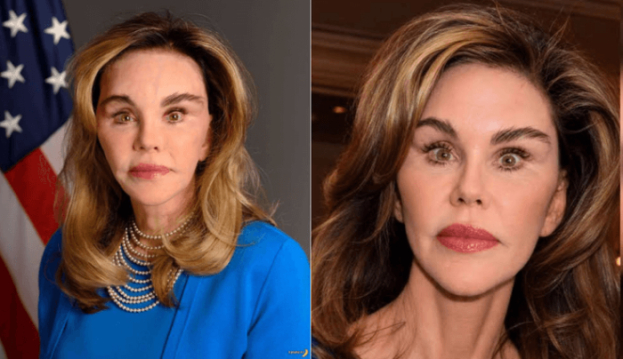
The latest wave of debate was sparked by a photograph of 78-year-old Barbara Thornhill, whom the Trump administration announced last month as its choice for a new State Department ambassadorial post. After her official portrait was released, users began Googling not her professional background but questions such as “What happened to her face?” and “What did she look like before?”, The Washington Post reports.
Thornhill's photograph triggered a social media frenzy. The post on X attracted more than 21 million views and around 15,000 comments. Users focused heavily on her appearance, bringing renewed attention to a distinctive look associated with some women in Trump's orbit: smooth foreheads, excessively full lips, sharply defined eyebrows and prominent cheekbones.
The look has become known as Mar-a-Lago face. The term gained popularity after similar features were noticed among women appointed by the president to public positions. Today, however, it is often applied more broadly to any Republican woman who has undergone conspicuous cosmetic procedures.
What is particularly striking is that the criticism is not coming exclusively from Trump's political opponents. Some conservative women themselves believe the pursuit of this look has gone too far.
“Being a beautiful woman means people will treat you better. That's a fact. But when you take it so far that you look like an actual doll, who's going to take you seriously? Nobody,” said Raquel DeBono, founder of the conservative organisation Make America Hot Again.
She argued that this aesthetic makes not only the women themselves look ridiculous, but also the political system and the White House. DeBono described the phenomenon as a form of “bimbofication” of women holding influential positions within the conservative movement.
Meghan McCain, the former co-host of The View, has also spoken out. Following the controversy surrounding Thornhill's photograph, she wrote that she would rather see Republicans put forward women who had not undergone “weird or botched plastic surgery”.
Similar ridicule was previously directed at Katie Zacharia, who served briefly as White House press secretary. Mother Jones also used the term “Mar-a-Lago face” to describe her appearance.
Experts suggest, however, that the phenomenon may have roots beyond individual aesthetic preferences. Some link it to the pressure women face in conservative political circles, where appearance can become one of the factors influencing career prospects.
Bridget Bosco, a former Republican congressional staffer, believes that imposed beauty standards can have a real impact on young women, particularly those seeking to build careers within the MAGA movement.
“Especially insecure women in the MAGA conservative movement are willing to do anything to feel important. If you're an ambitious woman, you use every tool available to get attention, because it's very difficult to climb the ladder. If you want to become a prominent figure, you have to fit what men want,” she explained.
Bosco said she had encountered unspoken expectations about appearance herself early in her career in conservative Washington. According to her, senior figures at two different right-wing organisations even brought or bought her clothes and shoes — something she experienced as a form of social pressure.
Cressida Heyes, a professor of political science and philosophy at the University of Alberta, points out that the defining feature of this look is its conspicuous artificiality.
“What's interesting is how obviously unnatural it is. There's no attempt to make subtle changes or achieve a result that could pass for a natural appearance. It's striking that people from a particular political group seem to believe they need to look this way to succeed in politics,” she said.
Juliet Williams, a professor of gender studies at the University of California, Los Angeles, believes Trump's second administration has intensified the focus on the appearance of women selected to work in his team.
“He is visibly promoting women with a very particular look and style. The message is clear: from the administration's perspective, a woman's value is closely tied to how she looks. If you don't fit the image, you won't get the job,” Williams explained.
Some observers suggest that the distinctive appearance may serve as a kind of badge of loyalty to Trump, a display of wealth and status, or a way of signalling conformity with the movement's gender norms. The White House declined to comment.
Plastic surgeon and conservative television host Sheila Nazarian offered a simpler explanation. In her view, the women may simply have chosen the wrong cosmetic practitioners, while their political opponents are using their appearance as an opportunity to attack them.
What particularly angers Nazarian is the reaction from users on the political left.
“It's funny how people talk so much about women's empowerment, yet they're the first to tear another woman down,” she said.
According to Nazarian, conservatives place considerable emphasis on physical fitness, nutrition, personal grooming and success, but are frequently mocked by their political opponents for doing so. “Why should someone be ridiculed for trying to stay young?” the surgeon asked.
Not everyone agrees that this aesthetic is exclusive to MAGA supporters. Wellness influencer Alex Clark Footberg, who supports the Make America Healthy Again movement, believes it is a much broader cultural phenomenon driven primarily by social media.
“This overfilled look is popular everywhere. You see women with this appearance in Beverly Hills just as often as in Mar-a-Lago. It's not exclusively a Mar-a-Lago phenomenon; it's more a feature of wealthy women in general,” she said. Clark also revealed that she used to get Botox injections but later gave them up in favour of facial tape, which she considers a more natural alternative.
Florida plastic surgeon Scott Ennis told The Washington Post that he has been advertising a procedure called “Mar-a-Lago face” at his clinic for several years. Initially, he used the term with reference to First Lady Melania Trump, whose appearance he regarded as an example of understated elegance.
Over the years, however, the meaning of the expression has changed. It is now increasingly associated with an excessively artificial look, prompting the surgeon to consider renaming the treatments he offers.
“People have started to interpret it as an overly artificial look rather than elegance. Over the past couple of years, the meaning of the term has changed completely,” Ennis explained.
The politicisation of women's appearance is also closely tied to Trump himself. The former reality TV star and ex-owner of the Miss Universe pageant has publicly commented on people's looks for decades.
Becoming president did not put an end to the habit. Last year, Trump called one female journalist a “piggy” and described another as “ugly”. Men are not spared either: the president regularly praises the appearance of his allies but can also publicly express his disapproval. At a Republican convention, for instance, he said of Ken Paxton, the Texas Senate candidate: “I don't particularly like the way he looks.” Paxton lost the election on Tuesday.
According to Professor Williams, although Trump criticises the appearance of both men and women, women in his inner circle are the ones who pay the highest price for this culture of ridicule.
“We have a president who has normalised making fun of women because of their appearance. And now we're seeing more and more women becoming targets of that kind of ridicule. It seems that women are paying a disproportionate price for it — even those who support Trump himself,” the expert concluded.