“The Devil Walks Among Us”: Prominent British Historian Explains Why He Believes Satan Exists
 14:37 29 November, 2026
Prominent British historian and writer A.N. Wilson has said he is convinced that the Devil exists and believes evil continues to influence the modern world. His reflections were prompted by the recent publication of entries from the personal diaries of the late Pope Francis, in which the pontiff described three encounters with Satan.
Wilson recalls that his first introduction to the idea of the Devil came in childhood, when he attended a Catholic primary school in Staffordshire. During morning prayers, the children would call upon the Archangel Michael to protect them from Satan's schemes and drive away evil spirits which, according to Christian tradition, roam the world in search of human souls.
In the 21st century, many regard such beliefs as relics of superstition and religious fear. However, the historian points out that even Pope Francis, who was often seen as an advocate of a more liberal and modern form of Catholicism, took the existence of Satan seriously.
According to the diary entries, the pontiff described three occasions on which he claimed to have encountered the Devil. The first took place in Buenos Aires, when he was still a bishop. As he was driving through the streets of his home city, the future pope saw him through the car window.
“I saw him from the car. I cannot forget his threatening yet seductive eyes,” Jorge Bergoglio recalled.
The second encounter, Francis claimed, took place in a Carmelite chapel during Mass. He described Satan's gaze as even more terrifying than before, comparing it to flashes of fire. To dispel the vision, the clergyman gripped his rosary and began praying to the Virgin Mary.
The third incident allegedly occurred after Francis had been elected pope. This time, he supposedly saw the Devil inside the Vatican itself and heard his triumphant voice.
“Now I have everything I wanted,” Satan reportedly said, according to the pontiff.
Wilson acknowledges that such accounts can easily be dismissed as the product of the religious imagination of someone raised in a traditional Catholic environment. However, he recalls the words of French poet Charles Baudelaire: “The greatest trick the Devil ever pulled was convincing the world he didn't exist.”
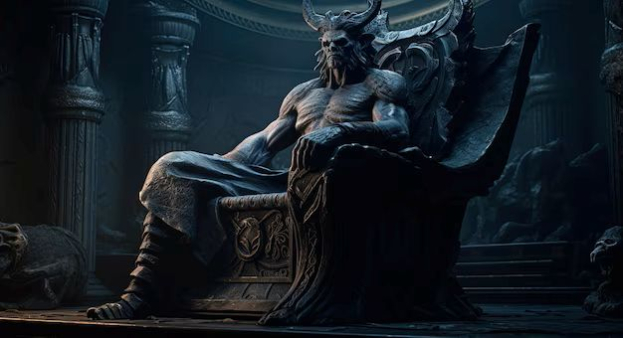
The historian also traces how Satan's image has evolved in culture and art. In the Bible, the Devil most often appears in the form of a serpent or dragon. However, as Christianity spread throughout the Roman Empire, his depiction began to take on features associated with pagan gods. In particular, he acquired horns and cloven hooves, resembling the appearance of the ancient Greek god Pan.
Later, fangs, scales and reptilian wings were added to the image, while the trident became one of the most recognisable attributes of the ruler of the underworld.
The Devil's image has also been repeatedly reimagined in literature. In John Milton's epic poem Paradise Lost, the fallen angel Lucifer gradually changes his form, transforming from a majestic being first into a toad and then into a serpent as he descends morally.
In the 18th century, German writer Johann Wolfgang von Goethe turned to the story of Faust, who makes a pact with the Devil. The legend became a symbol of the dangers of human ambition and the desire to gain power at any cost.
Wilson draws parallels between the eternal struggle of good and evil and the development of modern technology. As an example, he points to nuclear physics: one of humanity's greatest scientific achievements also led to the creation of weapons that destroyed Hiroshima.
The historian also turns his attention to cinema. Among the most memorable portrayals of Satan, he singles out Al Pacino's character in The Devil's Advocate and Robert De Niro's in Angel Heart.
But the interpretation of the Devil in Mel Gibson's 2004 film The Passion of the Christ made a particularly strong impression on him. Satan appears there as a pale, hooded figure with androgynous features, watching the suffering of Jesus Christ with disturbing curiosity and apparent delight.
In Wilson's view, this portrayal captures particularly well the Christian understanding of the confrontation between Christ and the forces of evil. Jesus' death on the cross is regarded as the ultimate victory over sin. However, according to traditional Christian doctrine, Satan continues to wield influence until the Last Judgment.
The historian notes that belief in demons and possession has not disappeared even in the modern world. He says that every diocese of the Church of England has at least one clergyman who performs exorcisms. Sceptics, however, explain such cases in terms of psychological disorders and mental illness rather than supernatural intervention.
Wilson maintains that participants in exorcism rituals sometimes report strange noises, furniture moving and other phenomena which, in their view, cannot be explained by a person's condition.
As a historical example, he also cites Nazi Germany. According to Wilson, Heinrich Himmler and the SS leadership were fascinated by occult beliefs and believed in the existence of dark forces.
In conclusion, Wilson admits that he has never seen the Devil himself or heard his voice. Nevertheless, events in the modern world make him reflect on the nature of evil. He points to political conflicts, the destruction of social institutions, the loss of historical memory, the rejection of established moral standards and the weakening of the sense of moral responsibility.
It is in these developments that the historian sees signs that evil has not disappeared. “Whatever you choose to call him — Satan, Beelzebub, Lucifer or Old Nick — for traditional believers he is a real being, the embodiment of something very real: evil,” Wilson concludes.