The Mysterious “Haunted House” in Central Yerevan: Who Designed the Building at 22 Moskovyan Street and Why Has It Stood Empty for Decades?
 16:33 29 November, 2026
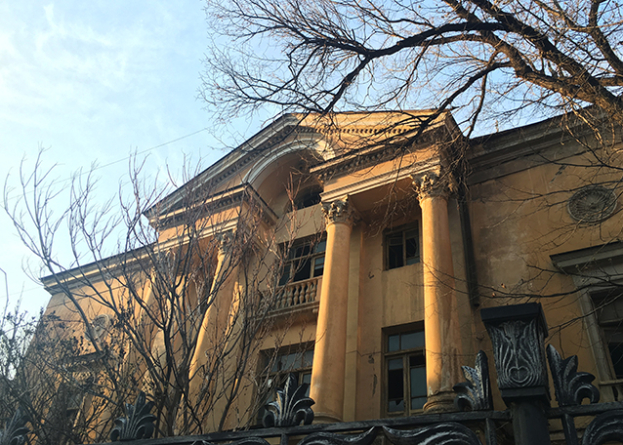
For years, a building at 22 Moskovyan Street, in one of the most beautiful parts of central Yerevan, has been catching the eye of passers-by with its architectural splendour and, at the same time, its neglected appearance. Built in the neoclassical style, it has remained unused for years and fallen into disrepair, despite having an owner.
Reliable information about the building's history is scarce, and some of the accounts that do exist are contradictory. As is often the case, a lack of facts has given rise to urban legends. Older Yerevan residents and fans of mysterious stories have long circulated rumours that, during the Soviet era, the building housed a secret chemical research institute. According to local lore, classified experiments were conducted there, and dangerous toxic chemicals — even radioactive substances — were stored on the premises. Some storytellers suggest that this is precisely why the building was later sealed off and came to be known as the “haunted house”.
Who actually designed the building?
The architect's name is rarely mentioned in publications about the building. One article claims that it was constructed in the early 1930s to a design by a female architect of Russian origin. But how accurate is that account?
Speaking to NEWS.am Style, an architect who asked to remain anonymous said that the building, designed in the style of Russian Classicism, was a fairly typical structure whose creator had, for reasons unknown, remained unidentified. He added that it was entirely possible the architect was not even Russian by nationality.
“Buildings of this kind can be found in major Russian cities, particularly Moscow and St Petersburg. So there is no need to regard this structure as an outstanding architectural monument.
It is a beautiful building, yes, and it certainly deserves to be preserved. Let's leave it at that, because there is not much more to say,” the architect concluded with a smile.
Meanwhile, art historian and architectural theorist Dmitry Kotov identifies Mark Grigoryan, an Honoured Architect of the Armenian SSR, as the author of the design in his article about the “House of Scientists”.
“This building stands out in Yerevan's urban landscape, differing noticeably from the surrounding architecture. Unlike most buildings in the city, its façade features none of the volcanic tuff characteristic of Armenian architecture. The masonry on the ground floor also lacks the roughly hewn basalt found in many neighbouring buildings from the same period.
“Interestingly, some of the modern luxury private residences now appearing in Yerevan also bear an obvious resemblance to the buildings under discussion, particularly the House of Scientists.
“Despite the unquestionable tradition, originality, uniqueness and canonical character of Armenian architecture, it could not remain entirely isolated from the influence of other cultures. In the 1920s–1950s, thanks to the efforts of Alexander Tamanyan, his students and associates, Armenia witnessed a revival and reinterpretation of its national medieval church architecture. This became the main source of inspiration for the design of new residential and public buildings. However, interest in the world's architectural heritage as a whole should not be ruled out either,” Kotov writes.
Another person who spoke to NEWS.am Style was journalist Mark Grigoryan, the grandson of Mark Grigoryan, the Honoured Architect of the Armenian SSR.
“Yes, the building has an architect, and it is my grandfather, Mark Grigoryan. The proof is a list of his architectural projects that he compiled in the 1960s, which includes this building,” Mark Grigoryan Jr. said. He added that in the 1980s he had donated the list, along with other archival materials, to the Yerevan History Museum.
According to the journalist, his grandfather faced criticism and attacks even from fellow architects. He was accused of “formalism” and “cosmopolitanism”, partly because of his admiration for the traditions of classical Greek and Roman architecture.
Why was the building called the “House of Scientists”?
The building was constructed in 1955 and initially allocated to Academician Armenak Mnjoyan. He established a pharmaceutical laboratory there, which later developed into the Institute of Fine Organic Chemistry. The institute soon moved to a new building on Azatutyan Avenue, where it remains today.
In 1965, a chemical physics laboratory founded by Academician Aram Nalbandyan began operating in the building. In 1975, it was transformed into the Institute of Chemical Physics. A new building was constructed for the institute in 1981, prompting its relocation. The former premises were then handed over to the Department of Applied Problems of Physics at the National Academy of Sciences of Armenia, which was later also granted institute status.
In 1982, part of the department moved elsewhere, but the experimental laboratory remained in the building and continued operating until 1992.
Back in the 1980s, Academician Sergei Mergelyan proposed turning the building into an international scientific centre called the “House of Scientists”. He envisioned hosting conferences and meetings with prominent researchers invited from around the world. In 1981, a sign bearing the words “House of Scientists” was even installed at the entrance. However, Mergelyan's project never came to fruition.
After Armenia gained independence, the building's premises were leased to various private companies, which used them as offices.
Is it true that chemical and radioactive substances were stored in the basement?
In 1995, the House of Scientists was removed from the National Academy of Sciences' balance sheet, transferred out of its ownership and sold to the Greek Embassy. However, the embassy never began renovating the building.
Rumours began circulating around the city that embassy staff were concerned about chemical and radioactive substances allegedly stored in the basement, particularly mercury.
In 2016, however, the Hellenic Republic Asset Development Fund, through its official representative and agent, the Bars real estate agency, announced an international open tender for the sale of the property.
In January 2018, it was purchased by prominent media executive and philanthropist Artur Janibekyan. The Bars real estate agency declined to disclose the sale price, citing commercial confidentiality.
After the purchase, the new owner said the building had been acquired to save it from further deterioration, preserve its architectural appearance and put it to cultural use. According to Janibekyan, the structure had been neglected for years and was gradually falling into ruin, making intervention necessary to prevent its eventual destruction. Although the building was not included on the list of protected monuments, it nevertheless had architectural value.
Janibekyan also said that only the dilapidated auxiliary structures on the property were to be demolished, with a landscaped green area created in their place. The main building, meanwhile, was intended to be used primarily for cultural projects.
As for the rumours about chemical and radioactive substances, one of Janibekyan's assistants said that an expert assessment had been commissioned before the purchase and had found no hazardous materials or other risks.
Yet the years have passed, and work on the renovation and improvement of the site has still not begun. NEWS.am Style sent a letter to Artur Janibekyan's office in the hope of receiving an update on the restoration and the building's future plans, but no response was received.