


NEWS.am STYLE

NEWS.am STYLE
NEWS.am STYLE
NEWS.am STYLE

The 23rd "Golden Apricot" Yerevan International Film Festival has kicked off

NEWS.am STYLE

NEWS.am STYLE

NEWS.am STYLE
NEWS.am STYLE

Nikos Vertis to perform in Armenia for the 3rd time at the invitation of “ACVA BUILDINGS”
NEWS.am STYLE

NEWS.am STYLE
NEWS.am STYLE
NEWS.am STYLE

NEWS.am STYLE

NEWS.am STYLE

NEWS.am STYLE

NEWS.am STYLE
The World’s First AI Art Museum Opens in Los Angeles — But Is It Actually Art?
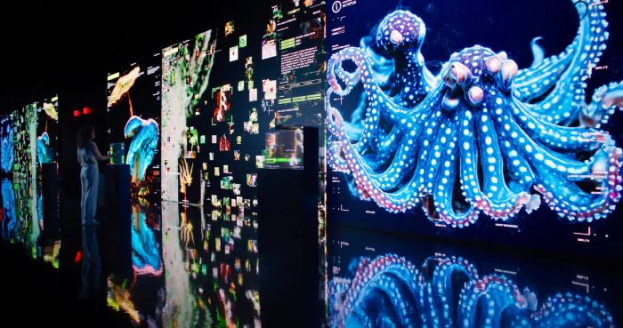
In this digital rainforest, everything moves at a breakneck pace, and life pulses all around you: right in front of your eyes, overhead, and beneath your feet, The Post reports.
A massive 360-degree cube invites viewers to plunge headfirst into a world of exotic flora and fauna before peering even deeper into the internal mechanics of nature, where tree sap pulses through a network of hidden channels.
The vibrant, ever-shifting imagery inside this windowless space is generated by 1,200,000,000 data points streaming in real time from 16 rainforests across the globe. These giant living canvases are accompanied by a massive, all-enveloping soundscape and a full palette of scents—ranging from floral and mossy undertones to subtle, "electric" notes.
This is the Data Pavilion inside Dataland, a project billed as the world’s first Artificial Intelligence Art Museum. Located at The Grand LA complex in downtown Los Angeles, it officially opens its doors on June 20.
Machine Dreams of Nature
The museum debuts with the exhibition “Machine Dreams: Rainforest”—an incredible immersive show that goes far beyond dry data analytics. It is, without a doubt, a museum experience unlike any other.
Created by artists Refik Anadol and Efsun Erkilic, this sensory explosion features four additional reality-bending galleries. Their atmosphere can be described as a hybrid of Alice in Wonderland and the movie Avatar, or perhaps a psychedelic version of The Backrooms creepypasta.
Erkilic tears up as she watches the first visitors walk through Anadol’s “Infinity Room.” The space transports the mind deep into the thicket of a digital Shangri-La, vividly showcasing both the majestic beauty of nature and its extreme fragility.
This feels nothing like a soulless tech attraction. This is machine-made art with a heart: a profoundly emotional experience that feels alive and genuinely intelligent.
Moreover, while you explore the 2,300-square-meter exhibition space (with an additional 1,000 square meters dedicated to server rooms and complex hardware), the "living museum" watches you right back. Upon entry, visitors are handed interactive sensor wristbands that track body temperature and heart rate, adapting the space to their physical state while special diffusers release customized scents.
To recreate the graphics projected onto the massive walls and reflected in the mirrored floors and ceilings, the AI system continuously processes signals from the wild.
"We are getting data directly from trees!" Anadol shares, beaming. "We capture soil moisture and the electromagnetic signals that trees send to one another. It’s an incredibly complex system."
Thanks to this stunning spectacle, the viewer can literally "understand the trees and how they communicate with each other," Erkilic adds.
Algorithms as Art: The Ethical Side
Dataland makes its grand entrance amid intense global debates surrounding AI-generated content—from text to music—and its encroachment on copyright and privacy laws. After all, the data used to train these models has to come from somewhere.
Refik Anadol, an internationally renowned media artist who has been working in this field for years, is acutely aware of the issue. He is convinced that if approached correctly, it is high time for algorithms to take their rightful place at the creators' table. For his museum, he sources data entirely ethically, partnering with Google, tech giant Nvidia, and the Smithsonian Institution.
"Our model is open-source and free to the public. This means that even the institutions that shared information with us can use it for their own purposes," Anadol explains.
Jenn Singer, founder of the Manhattan-based Jenn Singer Gallery and a longtime advocate for traditional artists' rights, praises Anadol's approach. "What’s valuable about Refik’s work is that he takes information from natural sources—from nature itself. He is very respectful of original sources and doesn’t violate anyone’s copyright."
Prominent gallerist Jeffrey Deitch, who exhibited Anadol’s “Living Paintings” project in 2023, also sees no threat in the technology. "AI is just a tool. The use of neural networks alone doesn’t make a piece interesting; I’ve seen plenty of terrible work made with AI."
When asked whether the world will eventually drown in a wave of tasteless digital "noise," Jenn Singer notes with a hint of sadness: "There’s going to be a lot of AI slop. Mountains of slop."
But Is It Actually Art? And Who Is the Author?
The central question remains open: can these algorithms truly be considered art? The answer, as always, lies in the eye of the beholder—after all, not everyone connects with the Mona Lisa.
However, another legitimate question arises: who is the true creator here—man or machine?
"Refik created the concept. He is the artist," Jeffrey Deitch states flatly.
Unquestionably, Anadol's work is powerful because of how it connects humans with nature. It is not just a kaleidoscope of color-saturated images; the exhibition metaphorically illustrates the extinction of hundreds of flora and fauna species every year.
"I appreciate that his work raises environmental and social issues. It gives it depth. When we exhibited his project on endangered coral reefs, it really drew public attention to the disaster," Deitch adds.
Efsun Erkilic shares a dream: she imagines legendary naturalist David Attenborough, who recently celebrated his 100th birthday, walking into their gallery, and the machine reacting to his presence. "That would be incredible," she smiles.
Monetization and Custom Merch
Still, "data painting" remains a controversial topic within the conservative art establishment. Notably, institutions like the Hammer Museum in LA, the Serpentine Gallery in London, LACMA, and The Broad either declined to comment or ignored press inquiries about the opening. The lingering hangover from the meteoric rise and thunderous crash of the NFT art trend in the early 2020s likely plays a role, leaving lingering doubts about how to sell dynamic digital art.
So, how does a museum packed to the brim with ultra-expensive systems and screens plan to turn a profit?
First, through ticket sales. Dataland operates from Tuesday to Sunday. Standard admission runs between $49 and $79, priority access costs $89 to $129, and annual memberships range from $350 to $1,500.
"And we also have a gift shop," Anadol adds with a sly smile.
This is far from your average postcard shop. While it does sell T-shirts, the prints are custom-generated based on the biometric data collected from your wristband during your walk through the galleries. Using that same data, a fragrance system can formulate and bottle your personalized scent right on the spot.
There is also a robotic arm named Qualia installed in the shop. It translates your vital signs into a physical object, picks up a brush, and paints "your portrait"—or rather, a completely unique abstract painting of your heartbeat.
Follow NEWS.am STYLE on Facebook, Twitter and Instagram

- A year aboard a luxury liner: £56,000 cruise spans the globe from Alaska to Zanzibar A two-week cruise may sound like the ultimate luxury. But what if you could spend an entire year at sea, waking up every day in a different corner of the planet...
- The garden’s fussy aristocrat: Essential Japanese maple care tips for a flawless red color Japanese maples (Japanese Acers) are true aristocrats of the garden — but they can be remarkably temperamental. To keep your tree displaying luxurious wine-red foliage, it needs the right care, the perfect location and one particularly important treatment...
- Buying century-old trees is the new status symbol among billionaires Today’s super-rich don’t want to spend years waiting for saplings to grow. The luxury landscaping industry is booming with a new obsession: transplanting enormous mature trees — from oaks and palms to baobabs and magnolias — directly into the estates of the wealthy, The New York Times reports...
- Jealousy over pixels: GTA 6’s ‘romantic’ features spark an online scandal The highly anticipated release of Grand Theft Auto VI — scheduled for November 19, 2026, on PlayStation 5 and Xbox Series X/S — has triggered an unexpected real-life controversy. Girlfriends, fiancées and wives around the world are reportedly threatening to boycott the game, arguing that virtual romances with its female protagonist, Lucia, amount to real-life cheating...
- Valentino Sciotti Brings the Fantini Story to Armenia Fantini Group founder Valentino Sciotti visited Armenia for the first time at the invitation of VINO&VINO. At VINO&VINO’s venue on Mashtots Avenue, he presented a selection of Fantini wines and met with Armenian wine enthusiasts, sharing the story of the brand, the principles behind his work and the regions that shape the character of its wines․․․




-
11:51, September 9
Trump’s Generous Gifts to Young Female Aides: Each Received $45,000 -
11:36, September 9
Elon Musk Wanted Children “Before the Civil War” and Offered $40 Million for Silence: Shocking Claims by His Former Partner -
10:43, September 9
Deep Plunges, Sheer Looks and Barely Any Fabric: Kim Kardashian Shares Archive of Revealing Fittings -
23:01, September 8
A year aboard a luxury liner: £56,000 cruise spans the globe from Alaska to Zanzibar -
22:23, September 8
The garden’s fussy aristocrat: Essential Japanese maple care tips for a flawless red color -
21:27, September 8
Buying century-old trees is the new status symbol among billionaires -
20:30, September 8
Jealousy over pixels: GTA 6’s ‘romantic’ features spark an online scandal -
19:30, September 8
Valentino Sciotti Brings the Fantini Story to Armenia -
19:15, September 8
Blood, Bones and Dracula: Antique Vampire-Hunting Kit Sends Online Auction Into a Frenzy -
16:32, September 8
Three Berlin men are ‘marrying’ each other — but there’s no sex: “We just love each other” -
15:39, September 8
Phoebe Bridgers shocks Venice with unshaved legs -
15:20, September 8
Teri Hatcher to become the new Miranda Priestly: Desperate Housewives star takes over the runway in The Devil Wears Prada
All materials

@NEWSam_STYLE
@NEWSam_STYLE
- Archive