Speaking about the events of 1915, facts and statistics are most often mentioned—around one and a half million victims, deportations, repression. But behind these numbers stand human lives that cannot be fully contained in any book or archive.
The stories presented in this article were passed down from generation to generation as family memory. They carry reality—lived, felt, and transmitted.
These are stories not only of loss, but also of life, endurance, and memory.
The spring of 1915 began as usual—calmly and routinely, without any sense that life would change forever in those very days.
“We didn’t understand where we were going… we just walked…,” he says, pausing for a moment. His hands tremble, his gaze drifts somewhere into the past.
“People were collapsing along the road; they no longer had the strength to go on…,” he continues slowly, with pauses. “We just walked… not knowing where we would end up…”
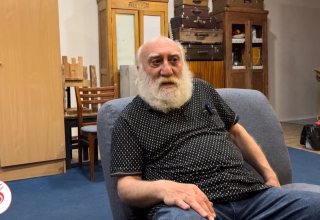
The only eyewitness to these stories is M. H., about 107 years old, who today returns to these memories with difficulty.
He remembers the courtyard of their home—sunlit and peaceful, where everything was in its place. He also remembers the day his father was taken.
“He didn’t say anything… he only looked at us with a long, silent gaze,” he says. That gaze became his last memory of his father.
Soon, the path of exile begins. The mother hurriedly places a few pieces of lavash and something sweet into the child’s pocket, embraces him, and steps out.
The road is long, тяжелый, sometimes impassable. People walk until their strength is gone. Many remain by the roadside.
“I understood even then—I had to survive,” he says in a heavy voice.
The story of crossing the Araks was passed down from his grandfather, and today it is recalled by the granddaughter, A. N.
The eldest son in the family carries his younger sister on his shoulders and promises the older one that he will return for her. But when he does return—he no longer finds her.
Years later, the children end up in an orphanage, then their uncle finds them. They grow up, start families, but the emptiness of the lost sister remains.
“Grandfather remembered, and every time his voice changed at this point,” the granddaughter says. According to her, he told this story with emotion, yet with a warm and bright gaze, because he always added: after this pain, life continued, and a strong Armenian family was formed.
In K. D.’s family, one of the heaviest memories is connected with her great-great-grandfather, who died on the road of exile.
A mother with five children was forced to dig the ground and bury him, placing a large stone on top as a sign—one day they would return and find him.
Another episode, no less тяжелый, is also told in the family. One of the brothers had mental difficulties and could not continue the journey. The mother stopped, gave him two pieces of cloth and bread, seated him by the road near a stone, and told him to wait for their return.
“I cannot imagine the feelings of a child…,” says K. D., noting that this silence and separation are still difficult to put into words.
M. G. speaks about a тяжелая family memory:
“My mother-in-law’s mother-in-law always repeated the same story. She said there came a moment on the road when they could no longer go on together.”
According to her, they had to leave a sick brother behind with the same promise—to return. But that never happened.
“That promise remained on the road… and probably with him,” says M. G.
M. E. recounts the long and difficult journey of his family, which began in the village of Nerkin Chiplik in Erznga and ended in Sisian.
“The only one who survived in our family was my father’s grandfather,” he says. According to him, he survived only because he joined the detachment of Andranik Ozanian.
“With them he reached Brnakot. Along the way, he saw much, but always spoke of it with heaviness,” he recalls.
In Sisian, he builds a house, starts a family, but the past does not let him go.
“Until the end of his life, he told the same stories… and every time he mentioned Andranik. Even on his gravestone, a commander on horseback is depicted,” M. E. recalls with a smile.
According to him, it was not just a name.
“It was as if it were the only connection to his lost world… something he held onto so as not to forget.”
In M. A.’s family, memories of the road of exile were passed down as a тяжелая, inescapable story.
He says he heard the story from his father. His father was born in 1915 in the village of Bulanlugh in the Mush district, when the village had already turned into a path of loss and flight.
“He was a newborn when the men of their quarter were taken away and shot… 40 people—in one pit,” says M. A.
Women with children in their arms set out on the road, not knowing where it would end. Along the way, they were forced several times to leave the infant behind—out of exhaustion and hunger—but then they would take him again and continue the flight until they reached Eastern Armenia.
M. A. remains silent for a long time, then says: “My father lost his mother at 12… and was left alone.”
But that loss was not the end. Years later, he built a life, married, and had five children.
“This is a story that began with loss, but continued with life,” he adds, tears in his eyes.
Another тяжелое memory of the same road is preserved in A. S.’s family. Today, this story is passed on through the great-granddaughter as unforgettable memory.
During the days of flight, a young mother, crossing the mountains, faces an impossible choice. The crying of her infant could expose the entire group, and she is forced to leave him on the road. “She could never tell this without tears… that moment always lived within her,” says the great-granddaughter.
A few days later, a young fighter finds the child alive and returns him to the mother. It seems like the end of the story, but years later their paths cross again.
This time—not as the saved and the savior. They marry. And the life that could have ended in those first days turns into the story of an entire family, continuing through generations as a destiny of survival and unexpected encounter.
There are stories that have reached us in fragments.
“In childhood, we listened to this like a fairy tale…,” says A. M., then falls silent.
“And when we began to understand what had really happened… there was no one left who could tell the details.”
According to her, great-grandfathers on both sides were six-year-old children—the only survivors in their families. They fled from Mush through the mountains, reaching Javakhk. One grew up in another family under their surname and never learned his real name.
“They said—he didn’t remember…,” she adds quietly.
And that forgotten name remained as a silent pain in the memory of generations.
A. G. says, recalling the stories of her grandparents:
“We listened to them… we remember, but they are no longer here to tell them again.”
Her grandfather was from Musa Ler—a place where seven villages resisted together so that the Turks would not enter their homes. This story became the basis of the book The Forty Days of Musa Dagh. After the massacre, his family resettled in Lebanon, in the Armenian village of Anjar.
“My grandfather later served in the army of Charles de Gaulle,” she says. At that time, Lebanon was under French control, and many Armenians joined French forces.
He lived to be 100 years old.
“There are many such stories… countless,” she says, then falls silent.
“But the people who lived through it are gone… only the stories remain… and sometimes old recordings, reports.”
The most important thing in these stories is that memory never ends.
Some tell what they saw themselves.
Others—memories of their grandparents.
Still others—as a continuation of generations—carry within them a story they did not live through, but which lives within them.
And it is in this continuation that the main value and strength of these stories lies.
Together, they create a complete picture where both tragedy and the continuation of life coexist. They show that within a single historical event, human destinies unfolded in different ways.
On the one hand—irreversible losses: children left on the road, relatives never found, lost graves. These stories remain unfinished; there is an emptiness in them that even time cannot fill.
On the other—examples of rescue and restoration. A saved child becomes the foundation of a family; a young man left alone builds a new life; memory is passed on through names, songs, and stories.
History shows: even in the most difficult conditions, human experience is never one-sided. It contains pain, resistance, and continuation.
These stories are important not only as testimonies of the past, but also as a way of preserving memory. They prove that memory can become a form of survival and be passed from generation to generation beyond time.
They were not written in books, not kept in archives, but lived in people. Passed on in whispers, in memories, in words within families.
April 24 is a reminder not only of loss, but also that memory continues as long as there are people who preserve it.
And as long as these stories are told, the past does not remain silent…
Mariam Asatryan
Tereza Minasyan
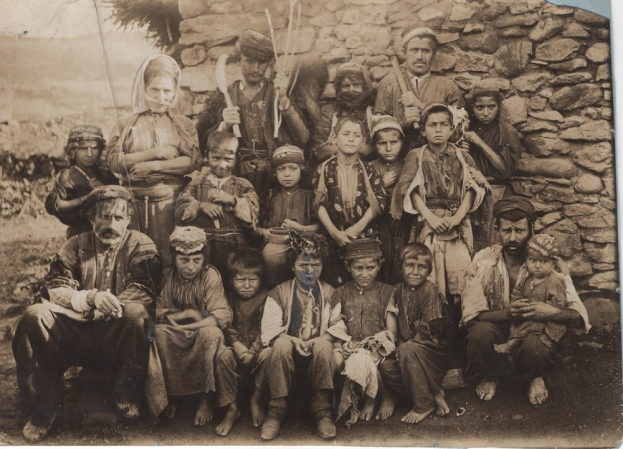
Photo: Armenian Historical Archives / ARF Archives in Watertown, Massachusetts