


NEWS.am STYLE

NEWS.am STYLE
NEWS.am STYLE

NEWS.am STYLE

The 23rd "Golden Apricot" Yerevan International Film Festival has kicked off
NEWS.am STYLE
NEWS.am STYLE

NEWS.am STYLE
NEWS.am STYLE

Nikos Vertis to perform in Armenia for the 3rd time at the invitation of “ACVA BUILDINGS”
NEWS.am STYLE

NEWS.am STYLE
NEWS.am STYLE
NEWS.am STYLE

NEWS.am STYLE

NEWS.am STYLE

NEWS.am STYLE

NEWS.am STYLE


The Ghost of Rutland Gate: Why Only a Homeless Man Lives at Britain’s Most Expensive Mansion
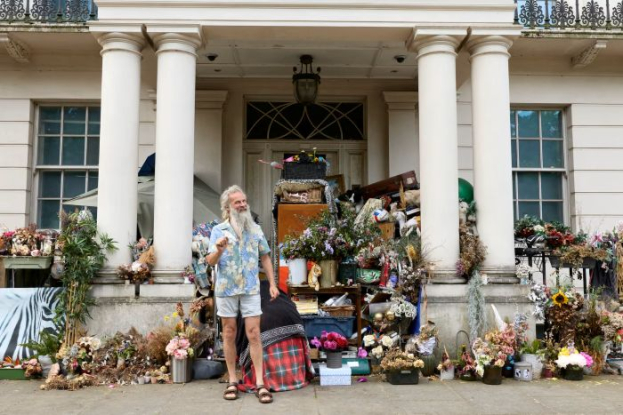
When this real estate marvel last changed hands in 2020, the mansion at 2-8A Rutland Gate officially became the most expensive home in the United Kingdom, selling for a staggering £210 million. However, the word "home" hardly does justice to this titan; "palace" is a far more accurate description, as The Guardian notes.

Situated in Knightsbridge, one of London's most ultra-exclusive neighborhoods, the colossal property boasts:
-
45 rooms and 4 private elevators;
-
Its own indoor swimming pool;
-
116 windows, 68 of which look directly out onto Hyde Park.
Yet, no one is admiring those views today. The palazzo has stood completely vacant for years. While thousands of Britons desperately search for stable housing, this abandoned castle serves as a stark, looming monument to the socio-economic reality of modern Britain.

Inside the palace, there is not a soul. But outside, right by the grand entrance, someone is home. Propped up against the pillared portico is a makeshift tent, constructed mostly out of umbrellas. From it emerges a bearded head—sleepy, yet remarkably friendly. This is Anders Fernstedt. His modest worldly possessions fill the space against the wrought-iron railings: baskets, books, newspapers, stuffed animals, a couple of bicycles, and countless vases filled with fresh flowers.
Behind the monumental doors guarding the palace's silence lie 24 marble bathrooms, once encrusted with semi-precious stones. Outside on the very same steps, Anders Fernstedt, who has called this porch home for three years, is forced to relieve himself in a plastic bottle.
"Everest base camp problems," Anders jokes. "You have to be clever enough not to climb out of the damn tent every single time nature calls."
From Lebanese Premier to Bankrupt Tycoon: The History of Cursed Gold
From the street, the building looks like a monumental residential block. Until the early 1980s, it was exactly that—a row of individual terraced townhouses—until they were bought out by the Lebanese billionaire Rafic Hariri, who would later become the Prime Minister of Lebanon.
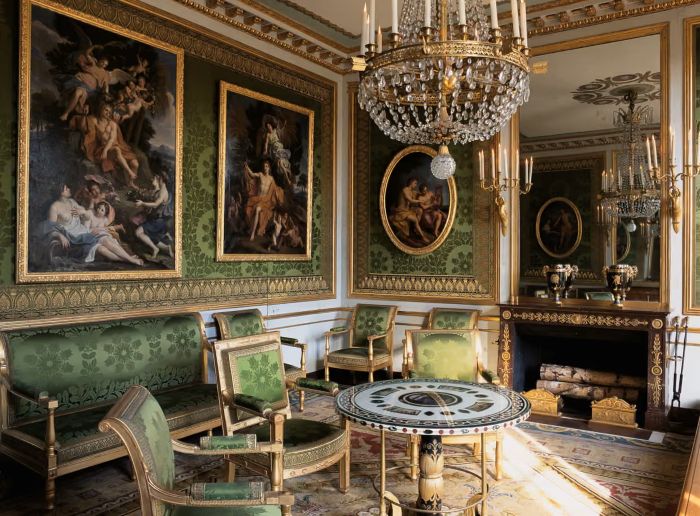
Hariri, who amassed his fortune building palaces for the Saudi royal family, demolished the internal walls and unified the properties into a singular, sprawling residence. He lived there like royalty—even the wastebaskets in the rooms were plated in 24-karat gold leaf. The lavish fairy tale ended abruptly in 2005 when Hariri was assassinated in a terrorist bombing in Beirut.
Following his death, the palace passed to Sultan bin Abdul-Aziz, the Crown Prince of Saudi Arabia. When he passed away in 2011, ordinary mortals finally got a glimpse of the mind-boggling luxury hidden inside: in 2015, the entire contents of the house—including gold-plated plumbing fixtures, gold buckets, Murano glass chandeliers, and Lalique crystal decanters—were auctioned off. Despite the record-breaking 2020 transaction, the fortress at Rutland Gate has remained derelict ever since.
While the house was formally acquired in 2020 by Hong Kong billionaire Cheung Chung-kiu, an investigation by The Financial Times revealed that the true beneficiary behind the deal was his close friend, Hui Ka Yan—the founder of the notorious, bankrupt Evergrande real estate empire and, at the time, China’s richest man.
Today, Evergrande’s liquidators are unable to seize the Rutland Gate mansion because, on paper, it is registered under the name of Hui’s ex-wife, Ding Yumei (the couple managed to divorce before the crash). Ding, who holds Canadian citizenship, cannot sell the property either, as her global assets have been frozen by a court order. The future of the palace is suspended in a legal vacuum.
Journalist, Botanist, and Friend to Swans: Who Is Anders Fernstedt?
The story of the man who colonized the porch of this offshore monument to human vanity is no less remarkable than the history of the building itself. Born in Sweden in 1968 to a librarian mother, Anders worked for a long time as a journalist.
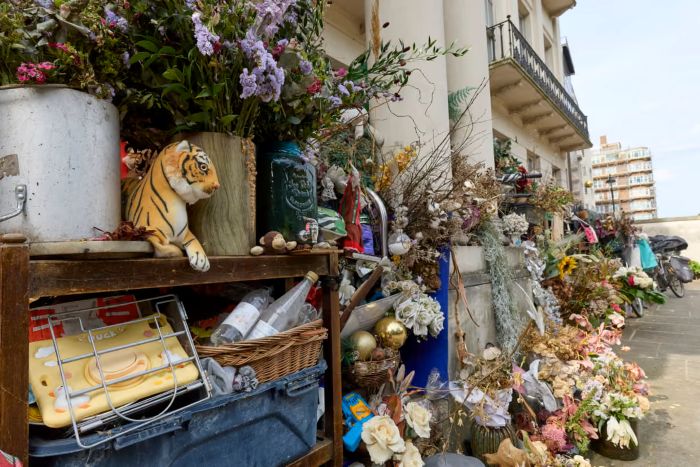
Later in life, he developed a passion for botany and even studied horticulture at the Royal Botanic Garden Edinburgh. This explains why his tent is constantly surrounded by live flowers. "This is my imaginary garden," he says with a smile.
Life has taken him on a wild ride: in the U.S., he was hit by a car, fracturing his spine in three places—yet he made a full recovery. He later worked as a fact-checker for The Economist in London, lived on a dilapidated 24-foot sailboat in Essex, and rode a Vespa moped he bought from a Florentine banker. But when the freelance gigs dried up and his boat was smashed to pieces in a storm, Anders quickly lost his footing.
Thus began his descent through the circles of temporary housing hell:
-
Tottenham: "Dante's upper circle of hell—it was livable."
-
Finchley: "An arson attack in the neighboring flat and being assaulted by an aggressive ex-convict."
-
Brent Cross: "Eighteen months being held hostage by a neighbor—a drug dealer with face tattoos. It ended when he sucker-punched me and ruptured my eardrum."
While Anders was in the hospital recovering, all his belongings, packed in boxes in the hallway for an upcoming move, were stolen. He had nowhere left to go.
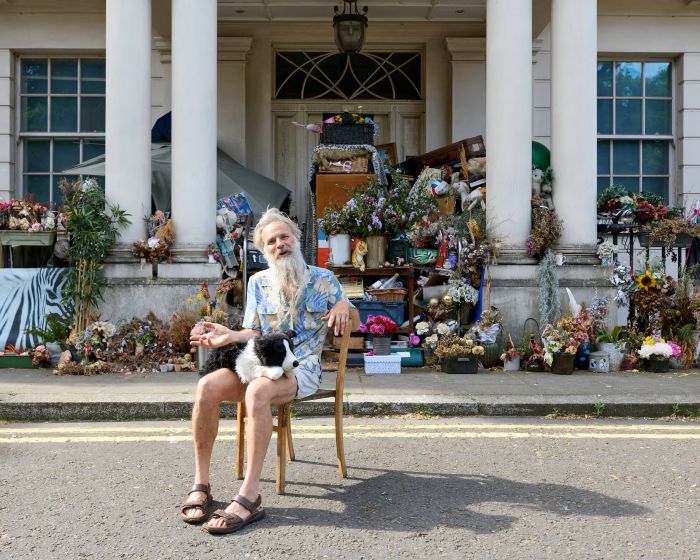
Fernstedt used to frequent the area to tend to the swans on the Serpentine lake in Hyde Park (coincidentally, he has a criminal record and a restraining order barring him from the park due to a confrontation with bystanders who objected to how closely the homeless man interacted with the royal birds). He noticed the vacant mansion with its massive monumental portico, which offered excellent protection from the rain, and moved onto the porch.
A Parallel Reality
Anders Fernstedt has developed his own unique psychological defense mechanism. "I’m this close," Anders says, pinching his fingers together to illustrate the thickness of the heavy oak front doors separating him from the opulent ballrooms. "You know what I tell myself? It's my imaginary reality. It’s like I'm a kid, my parents are inside, and I just asked them: 'Can I sleep in the treehouse tonight?' and I answer myself in a strict parental voice: 'Do you want to sleep in your room, son, or in the treehouse?' And I yell like a kid: 'The treehouse! The treehouse!' It keeps me going."
It is difficult to imagine a more visceral or brutal monument to the social inequality of modern Britain: an educated, penniless homeless man sleeping on a mat outside a vacant £210 million palace owned by a Chinese billionaire who, in all likelihood, has never even set foot inside.
Follow NEWS.am STYLE on Facebook, Twitter and Instagram

- The Boy Who Looks Like Boris Johnson: Why Steal Renoir at All? A robbery at the Louvre is easy enough to understand. Surely there isn’t a person alive who wouldn’t fancy hanging a Gericault or Leonardo in the guest bathroom. The same goes for the Musée d’Orsay and even the Centre Pompidou — French treasure houses crammed with extraordinary art practically begging for a daring heist. But the Renoir Museum? It is hard to imagine why anyone would bother, writes The Guardian...
- Labubu Meets LVMH: Pop Mart Opens Flagship Store in Paris Chinese collectible designer-toy maker Pop Mart International is continuing its aggressive global expansion despite some cooling in overseas sales. The company has announced the opening of its first European flagship store in Paris, on the prestigious Boulevard Haussmann, next door to the iconic department stores Galeries Lafayette and Printemps, according to the South China Morning Post...
- A year aboard a luxury liner: £56,000 cruise spans the globe from Alaska to Zanzibar A two-week cruise may sound like the ultimate luxury. But what if you could spend an entire year at sea, waking up every day in a different corner of the planet...
- The garden’s fussy aristocrat: Essential Japanese maple care tips for a flawless red color Japanese maples (Japanese Acers) are true aristocrats of the garden — but they can be remarkably temperamental. To keep your tree displaying luxurious wine-red foliage, it needs the right care, the perfect location and one particularly important treatment...
- Buying century-old trees is the new status symbol among billionaires Today’s super-rich don’t want to spend years waiting for saplings to grow. The luxury landscaping industry is booming with a new obsession: transplanting enormous mature trees — from oaks and palms to baobabs and magnolias — directly into the estates of the wealthy, The New York Times reports...




-
16:29, September 9
The Boy Who Looks Like Boris Johnson: Why Steal Renoir at All? -
15:49, September 9
Labubu Meets LVMH: Pop Mart Opens Flagship Store in Paris -
15:22, September 9
Where Has Lady Gaga Gone? Singer’s Disappearance Sparks Secret Wedding Rumors -
14:37, September 9
Current “Miss Austria” Dies Suddenly at 22 -
14:10, September 9
Cardi B Shows Off Her $15,000 Diamond Butt Piercing -
13:22, September 9
“No Kissing”: Billy Baldwin Vows Never to Work With Sharon Stone Again -
12:38, September 9
A Joke That Went Too Far: Gwyneth Paltrow Reveals How Her Viral “Vagina-Scented” Candle Came to Be -
12:17, September 9
Nicolas Cage’s $10.5 Million Luxury Malibu Mansion Nearly Swallowed by Giant Sinkhole -
11:51, September 9
Trump’s Generous Gifts to Young Female Aides: Each Received $45,000 -
11:36, September 9
Elon Musk Wanted Children “Before the Civil War” and Offered $40 Million for Silence: Shocking Claims by His Former Partner -
10:43, September 9
Deep Plunges, Sheer Looks and Barely Any Fabric: Kim Kardashian Shares Archive of Revealing Fittings -
23:01, September 8
A year aboard a luxury liner: £56,000 cruise spans the globe from Alaska to Zanzibar
All materials

@NEWSam_STYLE
@NEWSam_STYLE
- Archive