



NEWS.am STYLE
NEWS.am STYLE
NEWS.am STYLE
NEWS.am STYLE

NEWS.am STYLE
NEWS.am STYLE
NEWS.am STYLE

NEWS.am STYLE
NEWS.am STYLE
NEWS.am STYLE
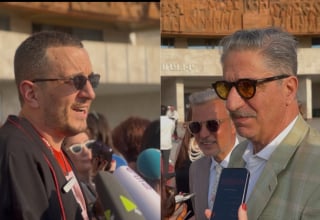
The 23rd "Golden Apricot" Yerevan International Film Festival has kicked off
NEWS.am STYLE
NEWS.am STYLE
NEWS.am STYLE
NEWS.am STYLE
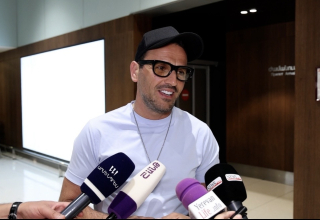
Nikos Vertis to perform in Armenia for the 3rd time at the invitation of “ACVA BUILDINGS”
NEWS.am STYLE
NEWS.am STYLE



"I Was Given a Second Chance. It Would Be Strange to Live It Without a Smile": Winemaker Aleksandr Arakelyan on Pursuing His Dream Against All Odds
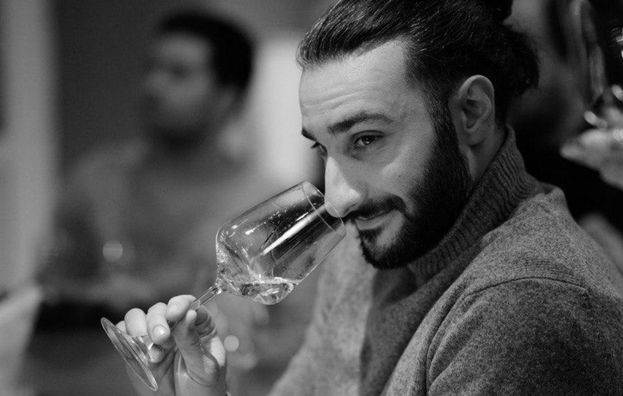
On a warm July day, we meet Alex at a small café near the Cascade. As sunlight washes over the white stone and tourists leisurely climb the stairs, he and I prepare to journey back into the past. Today, Aleksandr Arakelyan is a wine expert, oenologist, and the head winemaker at Alexandrea Winery. He spent years studying abroad, working in research laboratories, and mastering the craft, harboring a dream to one day become one of the top specialists in his field. But what was his journey from a student captivated by plant genetics to a man who lived through war, returned with two pieces of shrapnel in his body, and chose to dedicate his life not to the past, but to the future?
In an interview with NEWS.am STYLE, Aleksandr opens up about science, discovering his true calling, the reality of war, receiving a second chance at life, and why he believes that true patriotism doesn’t begin on the battlefield, but with a daily drive to better oneself and one's country.
A First Taste of Curiosity
"To be honest, my interest in wine started in childhood. I vividly remember my first glass of red wine. I was about ten years old, attending a massive family wedding with over a hundred relatives. My grandfather allowed me to try just one glass. I still remember that moment. It was the first time I realized that alcohol is intriguing, but demands respect. After that, we had an unwritten rule at home: no cigarettes and no alcohol until I turned of age. And I stuck to it.
Later on, my curiosity shifted specifically toward wine. Beer is something you can just drink without thinking much about it—especially back then, before Armenia developed a craft brewing culture. Wine is entirely different. The more you taste it, the more you notice the distinctions between grape varieties, styles, and regions. If someone doesn’t explain these nuances to you, you might not even perceive them. But once you understand why one wine differs from another, genuine curiosity takes root. That’s when I wanted to delve deeper. I became fascinated by barrels, amphorae, aging, and how different materials shape the wine's final flavor."
Searching for a Calling, Not Just a Degree
"By education, I am an agronomist, specializing in Plant Breeding and Genetics. We studied how to develop new plant varieties, cultivate them, and propagate them. I knew that with this knowledge, I could work with virtually any agricultural crop.
Many were surprised by my choice. Before university, I graduated from Yerevan’s Quantum College, so my teachers kept asking: 'Why the Agrarian University? You could have gone to the American University, the European University, anywhere you wanted.' My answer was always the same: if another university had a strong agricultural department, I would have gone there. But they didn't.
There were about a hundred and fifty students in my department. Frankly, it felt like I was practically the only one who had enrolled specifically for the profession itself.
I believe it is vital to figure out what you truly want to do as early as possible. They say time is life's most expensive commodity for a reason. If you want to be a winemaker, study winemaking. If you dream of being a doctor, become a doctor. It’s a tragedy when someone spends five years getting an education only to realize they've spent their youth on something they don’t care about. You can't afford to lose yourself. Everyone needs to find their exact rightful place."
Science Begins with Curiosity
At the time, Alex hadn't even considered winemaking as a career. He was far more captivated by pure science. During his studies, he began traveling abroad for internships, which opened his eyes to how differently the same field of education could be approached.
"In my third year, I went on my first internship to Norway. That was where I realized how far modern agricultural science had advanced compared to what we were studying back home. I can’t say we were taught poorly—on the contrary, I always found my classes interesting. But it was only when I stepped into a real research laboratory that I saw how science operates in practice.
I worked in a research greenhouse, studying a new variety of tomatoes. We conducted experiments and monitored plant development under fully controlled conditions. Later, our findings were published in a scientific paper, and I was named as one of the co-authors. That was my first real taste of science. Before that, research felt abstract; there, I realized that science is a relentless, hands-on pursuit of answers."
The Morning That Split Life Into "Before" and "After"
By that point, Alex had graduated from both the Agrarian University and the Vazgen Sargsyan Military University. His military training had run parallel to his academic studies: tactics, firing ranges, barracks life, and officer exams. Upon graduation, he was scheduled to be deployed as a lieutenant to Hadrout. He had exactly one month left before his deployment.
"After graduation, we stayed behind to train the new intake of cadets. Every young officer had a platoon they were responsible for. We trained the guys, helped them adjust, and prepared them for service. It felt like the beginning of a standard military career.
On the morning of September 27, I was awoken by phone calls. First a friend called, then my older brother. It was a Sunday, 8:00 AM. Honestly, at first, I didn't even want to pick up. Then I got a text: 'War has started.'
We were told that an alert had been issued and we needed to report to the Military University within a few hours. To be fair, I initially thought it was just a standard readiness drill. We had been warned multiple times that such surprise inspections could happen at any moment. I didn't even say anything to my mother. But when I arrived at the university, I instantly knew this was no drill. Everyone was packing massive military rucksacks, tents, weapons, and gear. The atmosphere was completely different. Our commander lined us up, gave final instructions, ordered us to take everything necessary, and within a few hours, transportation was organized.
We were ordered to reach our units by midnight. The six of us, all young lieutenants, were driven to Artsakh. A senior officer accompanied us nearly to the end of the road. By the time we crossed the border and reached Stepanakert, it was the dead of night. That was the moment the reality of war truly hit me. We were immediately ordered to turn off the headlights. Drones were constantly circling overhead in complete darkness. You could see almost nothing around you—only the distant echo of explosions and gunfire.
It felt surreal to me. Just a short while ago, I was a cadet, and now I was an officer in a warzone."
The most terrifying part, Alex recalls, wasn't just the constant sense of danger. It was facing a reality that no textbook could ever prepare you for.
"We were ordered to quickly draw weapons and take up positions. At the time, there weren't enough helmets to go around. We were issued body armor, but no helmets. That alone spoke volumes about how dire the situation was in those initial hours. Of course, in the military, you are trained to always be prepared for the worst-case scenario. That’s what tactics, strategy, and training are for. But when it unfolds in real life, the sensation is entirely different.
We spent the first few days in the trenches. There were already casualties there. Very young guys. Many of them hadn't even properly begun their service. We were practically the same age. The only difference was that I was already an officer, while they were just starting their path.
While we were holding our positions, wild blackberries were growing everywhere around us. Grapevines stretched along the roads. During brief lulls in the fighting, we would sometimes pick the berries right there. It struck me: war was raging all around us, yet nature kept living its life. It was then that I realized a simple truth: if you let your mind dwell only on death, you have already lost.
The romanticized notion of war vanishes incredibly fast. I distinctly remember a friend of mine, one of the most genuine patriots I have ever met. After our first night on the front lines—with almost no sleep, barely any food, and complete chaos around us—he looked at me and said: 'You know... patriotism feels entirely different on an empty stomach.' That phrase stayed with me for the rest of my life."
A few days after the war began, Alex was wounded. When recounting the event, he avoids graphic details or dwelling on fear. Instead, his memory holds onto distinct, sharply etched fragments of time.
"We had moved up to a position. Before taking our places, I managed to say just a few words to my men. At that exact moment, a strike came from above... I only remember a sharp, piercing sound, not even the blast itself. The next thing I knew, everyone was on the ground. Absolute silence filled my head, like a scene in a movie where everything turns gray. The pain was so intense I felt as though my legs were gone. My first thought wasn't about myself; I thought of my mother... about how she would find out.
A few seconds later, I started checking myself. I felt my legs, my back. I realized I was alive. I told myself: 'Alright, Alex, you didn't die. You’re just wounded. Stand up and run.' Later, I found out it was a drone strike. An artillery barrage followed, and I was eventually evacuated to a field hospital. Internal bleeding started there, and I was put straight onto the operating table...
I still have two pieces of shrapnel inside me. They will most likely stay there for good. Because of them, I can't undergo an MRI. If a day comes when it's absolutely unavoidable, we’ll decide whether they need to be removed. For now, doctors say it's best not to disturb them. Pulling them out could cause more harm than good."
It was after the war, Alex notes, that he finally gained absolute clarity on how he envisioned his future.
"My roots are in Artsakh. My grandparents, my entire lineage is tied to that land. Back then, defending it was my core ideology. I felt it was my duty to protect my home. But after the war, I realized that loving your homeland can take many forms. Yes, if necessary, we will defend it again. But it was during that recovery period that I firmly decided I needed to continue my education and gather as much knowledge as humanly possible."
This philosophy underpins our entire conversation. Alex rarely looks back; he is vastly more consumed by what lies ahead. He is convinced that true patriotism is measured not by sweeping rhetoric, but by an individual's daily actions.
"I feel that today is the exact moment we need to learn to believe again and start taking action. We cannot sit around waiting for someone else to come change things; we must build the future ourselves. Armenians have historically been called a nation of builders and creators. I believe it’s time to prove that once again. Everyone needs to commit fully to their craft. When people go to university just to collect a diploma and end up working in an entirely unrelated field, it becomes a systemic issue.
It is crucial to figure out your passion early on, because happy people build a happy country. If a society lives in a state of perpetual depression, the state eventually reflects that. I believe we need to shift our collective mindset. We cannot allow grief or depression to define our trajectory. We must remember our history, but we have an obligation to build a future."
Learning to Live Again
"After the war, many people asked if I had changed. Yes, profoundly so. But perhaps not in the way people assume. Despite everything I witnessed, I grew to appreciate life infinitely more. Of course, for a long time, I carried a heavy burden of survivor's guilt. Many of my friends never made it back, yet I survived. I constantly asked myself the same agonizing question: 'Why me?'
That feeling haunted me for nearly two years. I would wake up in the middle of the night, reliving it all, unable to fall back asleep. But gradually, I came to a vital realization: if I was granted a second chance, I am obligated to truly live. I have to live both for myself and for those guys who will never again get to smile, start a family, work, or chase a dream. I was given the gift of an extension on life. Turning my back on it by living in misery would be the ultimate disrespect to their memory.
I remember when I was in Switzerland, a guy looked at me once and said: 'Hey, why do you always walk around with such a serious face? Smile!' I just smiled back at the time. But later, it clicked—he was absolutely right. When you smile, you project positive energy to those around you. At some point, I realized that, truthfully, I have no reason to be resentful of life. I have a good life. I was given a second chance, and if I don't live it with a smile, it would simply be ungrateful."
Wine as a Medium to Tell Armenia's Story to the World
Today, Alex admits that the war reshaped his entire perspective on winemaking. While he was previously driven by the mechanics—experimenting, exploring grape blends, and studying the scientific facets of the trade—he now pairs that with a grander mission: ensuring Armenia is recognized globally as a country of exceptional wine.
"When I first heard the phrase 'Armenian wine renaissance,' to be honest, I didn't quite grasp what it meant. I remember traveling outside the city in 2015 to buy wine and being shocked by how limited the selection was. There were only a few bottles on the shelves, and practically nothing of note.
Today, the landscape is unrecognizable. Walk into almost any major store, and you'll find dozens of Armenian wineries represented. A massive paradigm shift has occurred over the last decade. To a large extent, this is because during the Soviet era, Armenian winemaking was completely overshadowed by brandy production. Armenian brandy achieved global fame, while wine was relegated to the background for decades. Now, we winemakers are actively rewriting that narrative."
Alex brings this wealth of knowledge to his role as head winemaker at Alexandrea Winery. For him, it’s far more than a workplace; it operates as a laboratory where he can endlessly research, experiment, and pioneer new approaches.
"I am incredibly fortunate to be here. At Alexandrea Winery, management trusts me to innovate and experiment. We work with both indigenous Armenian varieties and international ones. We are constantly studying how the same grape expresses itself across different vineyard plots, and how it is influenced by soil types, microclimates, aging lengths, and different varieties of oak barrels.
We cultivate more than ten grape varieties, and each requires a bespoke approach. Sometimes you age the exact same base wine in three different types of barrels, and you end up with three entirely distinct wines. That is exactly what captivates me. It's not just production; it’s a continuous body of research.
I love that Alexandrea Winery isn't afraid to chart new territory. It allows us to introduce unusual blends, new varieties, and fresh concepts. We don't want to copy anyone else. On the contrary, we want to carve out our own signature style and showcase what modern Armenian wine is capable of.
When our Pinot Noir won a gold medal at the Concours Mondial de Bruxelles, it was validation that we are moving in the right direction. Moments like that prove that Armenian wines can stand shoulder-to-shoulder with the best on the global stage. And I want to see these success stories multiply."
A Lifelong Dream
"Of course, I have a dream. I want to become one of the best winemakers in the world. I’ve never hidden that ambition. But for me, this isn't a vanity project. I want Armenian winemaking to elevate alongside me. I want people to talk about our wines not just because they come from a country with ancient history, but because they genuinely rival the finest bottles in the world.
I don’t know how to stand still. I am possessed by a constant hunger to learn. New research, new technologies, and new methods emerge globally every single day. The moment you decide you know everything is the exact moment you start falling behind. That’s why I keep studying—and I think I’ll be a student for the rest of my life."
By Liana Aghajanyan
Follow NEWS.am STYLE on Facebook, Twitter and Instagram

- Armenia wins Junior Eurovision 2026 The Junior Eurovision 2026 contest has ended in Malta, with Armenia's representative Nare being declared the winner with the song Boo…
- Armenia's Representative Nare's Performance at the Junior Eurovision Song Contest 2026 The Junior Eurovision Song Contest 2026 is underway in Malta…
- LIVE: Junior Eurovision 2026 has started in Malta. Armenia will perform under the number 8 The “Junior Eurovision” song contest is currently taking place in Malta, where Armenia is represented by Naré with the song Boo…
- AI-Generated Singer Announces Pregnancy and Quits Band — Fans Didn’t Realize She Wasn’t Real Social media users were left confused after news broke that Mity, a member of the Chinese pop group Baby Queen, had announced her pregnancy and decided to take a temporary break from the band. Many fans only then discovered that the group and its members were entirely AI-generated, the Daily Mail reports...
- Three Hours for Makeup and Household Chores: Japanese Prime Minister’s Admission Sparks Public Debate Japanese Prime Minister Sanae Takaichi has said her daily schedule is significantly more demanding than those of her male predecessors. In addition to her official duties, she spends several hours a day on makeup, bathing, cooking and other household tasks. Her remarks have sparked a heated debate about gender stereotypes and the expectations placed on Japanese women, The New York Times reports...




-
01:22, October 25
Armenia wins Junior Eurovision 2026
-
00:16, October 25
Armenia's Representative Nare's Performance at the Junior Eurovision Song Contest 2026 -
23:00, October 24
LIVE: Junior Eurovision 2026 has started in Malta. Armenia will perform under the number 8 -
19:30, October 24
“Kim Kardashian Could Become President”: Biographer Reveals Her Family Secrets, Scandalous Past and Obsession with Fame -
17:25, October 24
AI-Generated Singer Announces Pregnancy and Quits Band — Fans Didn’t Realize She Wasn’t Real -
16:34, October 24
Salma Hayek’s Daughter Tops Britain’s Most Eligible List: Billionaire Parents, Pubs and Vodka -
15:10, October 24
Timothée Chalamet Ignores Victoria’s Secret Models for Kylie Jenner — His Reaction Goes Viral -
14:20, October 24
Queen Elizabeth II Bragged About Helen Mirren to a Sheikh — But He Didn’t Recognize the Actress -
13:49, October 24
Why Did Tom Cruise Punch Jack Nicholson? -
13:15, October 24
“I Know Where You Are”: Hunter Biden Accused of Threatening Sex Worker -
12:12, October 24
Kim Kardashian Opens Up About Her Romance with Lewis Hamilton: “I’m Very, Very Happy” -
11:19, October 24
A $3 Million Rolex, a $200,000 Hermès Bag and a 7-Carat Diamond: Cardi B Spoils Herself with Lavish Birthday Gifts
All materials

@NEWSam_STYLE
@NEWSam_STYLE
- Archive