



NEWS.am STYLE

NEWS.am STYLE

NEWS.am STYLE

NEWS.am STYLE

The 23rd "Golden Apricot" Yerevan International Film Festival has kicked off

NEWS.am STYLE

NEWS.am STYLE

NEWS.am STYLE

NEWS.am STYLE

Nikos Vertis to perform in Armenia for the 3rd time at the invitation of “ACVA BUILDINGS”

NEWS.am STYLE

NEWS.am STYLE

NEWS.am STYLE

NEWS.am STYLE

NEWS.am STYLE

NEWS.am STYLE

NEWS.am STYLE

NEWS.am STYLE


iPhone from 1937: A Nearly 90-Year-Old Painting Sparks a Bizarre Conspiracy Theory
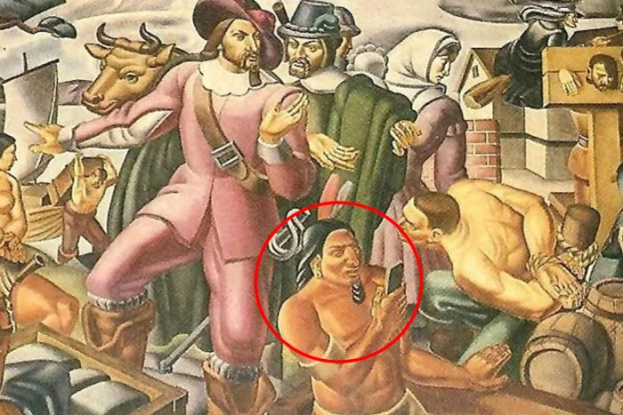
A nearly 90-year-old painting has sparked a furious online debate and given rise to a bizarre conspiracy theory, with social media users convinced that an Indigenous man depicted in the artwork is holding a modern-day smartphone, the New York Post reports.
The painting in question is Mr. Pynchon and the Settling of Springfield, a mural created by Italian-American muralist Umberto Romano. It depicts a Native American man surrounded by members of his tribe and early English settlers in 17th-century Springfield, which at the time was part of the Massachusetts Bay Colony.
“iPhone JUST DISCOVERED in a 1937 painting???” one X user posted Tuesday. “This time the device really does look like a cell phone,” another commenter agreed.
Claims of “time travel” took off after eagle-eyed users noticed the strange object.
The man appears in the foreground of the mural, painted in 1937. He is intently studying a rectangular object that appears to be charcoal black, with a shiny chrome-like or reflective frame.
As X users pointed out, the mural is housed in a Massachusetts state government office building that was formerly Springfield’s main post office. According to the Smithsonian’s National Postal Museum, it was one of six murals Romano created with students with funding from the Federal Art Project, a government program that employed artists during the Great Depression from 1935 to 1943.
Despite the wild speculation online, historians agree that the object in the man’s hands is simply a mirror.
Mirrors were common trade goods in 17th-century American colonies, making it perfectly plausible that the man would be so fascinated by his own reflection.
The “Mr. Pynchon” depicted in Romano’s mural was one of the founding figures of modern-day Springfield. William Pynchon arrived in Massachusetts from England, purchased land from the local Agawam people in 1636 and became one of the settlement’s leaders.
According to the Smithsonian, Romano consulted local historian Harry Andrew Wright and writer Esther Forbes to ensure historical accuracy, seeking to portray the development of the region from 1636 to 1936.
Follow NEWS.am STYLE on Facebook, Twitter and Instagram

- iPhone from 1937: A Nearly 90-Year-Old Painting Sparks a Bizarre Conspiracy Theory A nearly 90-year-old painting has sparked a furious online debate and given rise to a bizarre conspiracy theory, with social media users convinced that an Indigenous man depicted in the artwork is holding a modern-day smartphone, the New York Post reports...
- The Boy Who Looks Like Boris Johnson: Why Steal Renoir at All? A robbery at the Louvre is easy enough to understand. Surely there isn’t a person alive who wouldn’t fancy hanging a Gericault or Leonardo in the guest bathroom. The same goes for the Musée d’Orsay and even the Centre Pompidou — French treasure houses crammed with extraordinary art practically begging for a daring heist. But the Renoir Museum? It is hard to imagine why anyone would bother, writes The Guardian...
- Labubu Meets LVMH: Pop Mart Opens Flagship Store in Paris Chinese collectible designer-toy maker Pop Mart International is continuing its aggressive global expansion despite some cooling in overseas sales. The company has announced the opening of its first European flagship store in Paris, on the prestigious Boulevard Haussmann, next door to the iconic department stores Galeries Lafayette and Printemps, according to the South China Morning Post...
- A year aboard a luxury liner: £56,000 cruise spans the globe from Alaska to Zanzibar A two-week cruise may sound like the ultimate luxury. But what if you could spend an entire year at sea, waking up every day in a different corner of the planet...
- The garden’s fussy aristocrat: Essential Japanese maple care tips for a flawless red color Japanese maples (Japanese Acers) are true aristocrats of the garden — but they can be remarkably temperamental. To keep your tree displaying luxurious wine-red foliage, it needs the right care, the perfect location and one particularly important treatment...




-
19:38, September 9
iPhone from 1937: A Nearly 90-Year-Old Painting Sparks a Bizarre Conspiracy Theory -
16:29, September 9
The Boy Who Looks Like Boris Johnson: Why Steal Renoir at All? -
15:49, September 9
Labubu Meets LVMH: Pop Mart Opens Flagship Store in Paris -
15:22, September 9
Where Has Lady Gaga Gone? Singer’s Disappearance Sparks Secret Wedding Rumors -
14:37, September 9
Current “Miss Austria” Dies Suddenly at 22 -
14:10, September 9
Cardi B Shows Off Her $15,000 Diamond Butt Piercing -
13:22, September 9
“No Kissing”: Billy Baldwin Vows Never to Work With Sharon Stone Again -
12:38, September 9
A Joke That Went Too Far: Gwyneth Paltrow Reveals How Her Viral “Vagina-Scented” Candle Came to Be -
12:17, September 9
Nicolas Cage’s $10.5 Million Luxury Malibu Mansion Nearly Swallowed by Giant Sinkhole -
11:51, September 9
Trump’s Generous Gifts to Young Female Aides: Each Received $45,000 -
11:36, September 9
Elon Musk Wanted Children “Before the Civil War” and Offered $40 Million for Silence: Shocking Claims by His Former Partner -
10:43, September 9
Deep Plunges, Sheer Looks and Barely Any Fabric: Kim Kardashian Shares Archive of Revealing Fittings
All materials

@NEWSam_STYLE
@NEWSam_STYLE
- Archive