



NEWS.am STYLE

NEWS.am STYLE

NEWS.am STYLE

How Nare was welcomed at Zvartnots Airport after winning the Junior Eurovision Song Contest: the singer's emotions

NEWS.am STYLE
NEWS.am STYLE
NEWS.am STYLE

NEWS.am STYLE

NEWS.am STYLE

NEWS.am STYLE
NEWS.am STYLE

NEWS.am STYLE
NEWS.am STYLE
NEWS.am STYLE
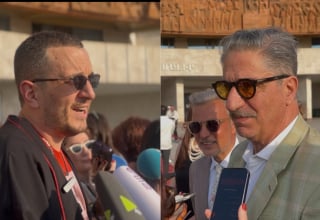
The 23rd "Golden Apricot" Yerevan International Film Festival has kicked off

NEWS.am STYLE
NEWS.am STYLE

NEWS.am STYLE


Exhibition-performance KOCHAR 360°: Yervand Kochar's creativity through prism of music, choreography, AI

The interactive exhibition-performance KOCHAR 360° opened at the National History Museum of Armenia; it is dedicated to the 125th birth anniversary of the great Armenian artist and sculptor, Yervand Kochar. This unique installation, created by Armenian and French cultural organizations, immerses viewers in the multi-layered world of Kochar’s imagination—a space where philosophy and art are combined.
The project is organized by the cultural public organization Art-image, with the support of the Yervand Kochar Museum, French theater association Sate-Athg, and famous dance company Kafiga.
View this post on Instagram
The creative process is led by French choreographer Mourad Merzouki and director Saten Khachatryan, who have combined various forms of art, dance, live music, and projections that envelop the space, like tangible dreams of the artist. Each element of the performance harmoniously merges, creating a captivating, profound atmosphere where the boundaries between the past and the future seem to dissolve in rhythms and shadows, and the viewer finds himself in a timeless space.
“It is very important for our theatrical art to popularize Armenian culture,” says project director Saten Khachatryan. “That is why the previous project was dedicated to [famous Armenian filmmaker Sergei] Parajanov, and this project is dedicated to Kochar. And I am sure that our dialogue between different types of art, forms of thinking, and philosophy through creativity is what makes these works universal.”

She emphasizes that this is not just an experiment for the sake of an experiment. “How do we look to the future? How do we transfer classical art? This was a long-term reflection which we worked on for a long time.”
The installation invites viewers into the world of Yervand Kochar—a world where light and shadows live their own mystical life. Against the backdrop of techno music and opera singing, archival recordings of the artist himself are heard. And throughout the exhibition, the dancers—like silent muses—are constantly moving, embodying the mystical soul of Kochar. Their abstract figures glide chaotically across the stage, sometimes running, sometimes smoothly hovering in space, as if becoming part of the installation itself.
In time with the music, they sometimes rapidly bend, then freeze in bizarre poses, stretching out their arms to the audience, as if calling them into the mysterious world of the artist. Their images, like living symbols, sometimes rise upward, as if striving for the sky, then silently fall down, bringing an element of almost sacred worship of art into the atmosphere of the performance.

The artist's voice carries philosophical reflections on the role of art, inspiration and the human soul, leaving on the brink of silence the question of the future of art, its possibilities and boundaries.
At some point, viewers see the figures of dancers who disappear into the darkness, as if the embodiment of the continuous movement of Kochar's soul. These images live and fade, but do not disappear, as if the artist left them to continue their dancing life in the memory and imagination of everyone.
A special feature of this project was the animation created with the help of artificial intelligence (AI). The neural network, having studied Yervand Kochar's works, recreated projections that seem to float in the air, sometimes appearing, sometimes disappearing, immersing viewers in a hypnotic flow of visual images that flow from one form to another—like Kochar's own paintings come to life. This approach made it possible to create the effect of the viewer's complete presence in the space of art where the classics are intertwined with advanced technology, reflecting the boundlessness of his artistic vision.

According to Saten, in this project Yervand Kochar is presented not only as a great artist, but also as a symbol of the link between times and cultures, a voice that can be understood by everyone. “There is nothing fictitious here, so we present it as it is,” she adds. “Everything is so abstract that each viewer sees and feels this work for themselves, each one lives their own personal story.”

And this desire to make Yervand Kochar’s art close to viewers from various countries is reflected in Saten’s hope: “For Kochar to become known in neighboring countries, for Kochar’s art to reach the whole world, and for our cooperation with organizations to become permanent. After all, this is an important part of the spirit of Armenia.”
By Liana Aghajanyan
Follow NEWS.am STYLE on Facebook, Twitter and Instagram

- Armenian Heritage in the World of Luxury: From Petrossian Caviar to a Schiaparelli Sweater From Petrossian black caviar and Serapian handbags made in Milan to Boghossian diamonds in Geneva, bespoke Rolls-Royces commissioned by an oil heir and jewelry favored by Hollywood stars, Armenian names have long been woven into the fabric of the luxury industry. Behind some are family empires; behind others, creations that have become part of fashion and automotive history...
- Richard Branson and Ray Dalio Have No Tolerance for Office Gossip: Why Some Billionaires Are Willing to Fire Employees Over It Men who gossip about their colleagues behind their backs could be putting their careers at risk. A new study by the University of Iowa and the University of New Mexico has found that men who gossip are perceived as less competent and are less likely to be seen as leadership material than women who engage in exactly the same behavior....
- Oat and Almond Milk Could Put Your Health at Risk, Scientists Warn Switching from cow’s milk to plant-based alternatives such as oat and almond drinks or coconut yoghurt could leave people short of essential nutrients. That is the conclusion of British researchers whose findings have been published in the journal The Lancet Planetary Health...
- “The Worst TV Show of the 21st Century”: Kim Kardashian and Glenn Close’s Legal Drama Slammed by Critics in Season Two Ryan Murphy’s legal drama All’s Fair, starring Kim Kardashian, Glenn Close and Naomi Watts, has been hit by another wave of scathing reviews. Critics have branded its second season “unbearably awful”, while one reviewer has gone so far as to call it “the worst TV show of the 21st century”...
- Jane Birkin’s Personal Hermès Bag, Complete with Her Signature and Handwritten Message, Heads to Auction A rare Hermès Birkin 30 once owned by Jane Birkin is set to go under the hammer in Paris. The bag’s particular appeal lies in the actress’s autograph and a handwritten message addressed to a friend named Georgia, Robb Report reports...




-
19:37, November 8
Armenian Heritage in the World of Luxury: From Petrossian Caviar to a Schiaparelli Sweater -
18:18, November 7
Richard Branson and Ray Dalio Have No Tolerance for Office Gossip: Why Some Billionaires Are Willing to Fire Employees Over It -
17:33, November 7
Robert Pattinson and Nicholas Hoult Join the Race to Become the Next James Bond -
16:37, November 7
Lavish Birthday at Taxpayers’ Expense: Ivanka Trump’s Security in Morocco Cost $93,000 -
15:29, November 7
Jessica Simpson’s Sexual Renaissance: 46-Year-Old Star Is Head Over Heels for Younger Boyfriend -
14:23, November 7
Oat and Almond Milk Could Put Your Health at Risk, Scientists Warn -
13:23, November 7
Threw a Plate of Spaghetti in Her Face: Bride Explodes After Bridesmaid Refuses to Gain 120 Pounds -
12:21, November 7
Bridgerton Star Sabrina Bartlett Marries Businessman Lachie Stewart in Romantic Tuscan Wedding -
11:18, November 7
Khloe Kardashian’s Ex-Husband Makes More Than $50,000 on OnlyFans in Just Eight Days -
10:30, November 7
Meghan Markle’s Father Led Away in Handcuffs From Nursing Home: He Faces Up to 20 Years in Prison in Child Sexual Abuse Material Case -
23:01, November 6
Kering’s Creative Shake-Up: Pierpaolo Piccioli Exits Balenciaga After Two Other Designers Leave -
22:33, November 6
Mother-in-Law vs Daughter-in-Law: Nicola Peltz Appears to Be Copying Victoria Beckham’s Most Iconic Looks
All materials

@NEWSam_STYLE
@NEWSam_STYLE
- Archive